Ghosts of Kyle Field
You’ve seen them wrecking offensive lines on Sundays, but the secret behind the NFL’s most terrifying edge rushers and game-wrecking linebackers starts long before draft day—it starts deep in the heart of College Station. Most modern fans stare at the shiny SEC graphics, the state-of-the-art training facilities, and completely ignore the literal blood, sweat, and broken bones that built this program from the ground up. Stop falling for the glitz. Ignoring the grit disrespects the foundation, leaving you completely clueless about what it actually takes to survive the grind of a professional football season.
The billion-dollar TV deals and modern SEC pageantry of today’s college football owe absolutely everything to the unapologetic grit of Texas A&M’s undisputed legends, whose off-the-field intensity is even more fascinating than their on-field accolades. Walk past the statues tonight. They look frozen and peaceful. Don’t let the bronze fool you. Those plaques hide brutal locker room battles, suffocating Texas heat, and grueling summer regimens that forged the best Texas A&M players into actual gods of the gridiron.
The current spotlight exists solely thanks to the savages who played through blinding pain before NIL money existed, before transfer portals offered easy ways out, and before national television cameras documented every single practice rep. To understand Texas A&M football is to understand a culture built on defiance, military-style discipline, and a psychotic refusal to stay down when hit. Want to know who the greatest Texas A&M football players and coaches of all time really are? Keep reading.
The Ultimate Standard: E. King Gill and the 12th Man
Before we talk about the modern titans, you have to understand the psychological bedrock of this entire university. It goes back to January 2, 1922, at the Dixie Classic in Dallas. Texas A&M was playing the powerhouse Centre College. The game was a literal meat grinder. Injuries were piling up at an alarming rate, and head coach Dana X. Bible realized he was down to his last few reserves.
Bible looked up into the press box and called down E. King Gill, a squad player who had quit football to focus on basketball. Gill didn’t hesitate. He rushed under the bleachers, stripped off the uniform of an injured teammate, put it on, and stood on the sideline for the rest of the game, ready to bleed for his team if his number was called. He never actually played a snap that day, but his willingness to step into the fire birthed the greatest tradition in college sports: The 12th Man.
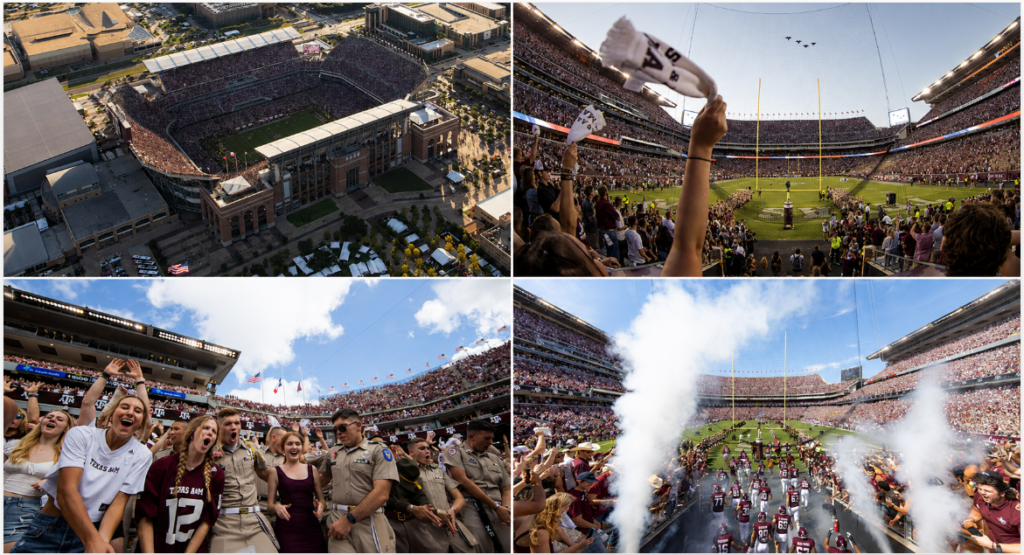
This isn’t just a cute story for a campus tour; it is the fundamental DNA of the program. When 100,000 Aggies stand up inside Kyle Field today, they aren’t just stretching their legs. They are actively mirroring Gill’s readiness to go to war. If you don’t understand that level of terrifying loyalty, you will never understand how this team recruits, trains, or breaks its opponents.
The 1939 Peak: Homer Norton and the National Championship
You cannot talk about the Mount Rushmore of Aggie football without bowing your head to Homer Norton and the legendary 1939 National Championship squad. In an era where football was essentially organized warfare in leather helmets, Norton built a roster of iron-jawed brawlers who refused to be scored upon.
Led by legendary fullback John Kimbrough—a human battering ram who hit the line of scrimmage with the subtlety of an asteroid strike—the 1939 Aggies didn’t just go undefeated. They shut out more than half of their opponents. Kimbrough was a two-time All-American who embodied the rough-and-tumble spirit of Depression-era Texas. Opposing linebackers documented waking up in cold sweats knowing they had to step into the gap against Kimbrough the next day. Norton’s aggressive, heavy-hitting offensive scheme, combined with an impenetrable defensive wall, permanently etched Texas A&M into the national college football conversation.
The First King: John David Crow and the Bear Bryant Era
Travel back to the sun-baked dirt of Junction in the summer of 1954. Bear Bryant ran a literal survival camp out there, intentionally weeding out the weak. He dragged his players into the desolate Texas hill country, cut off their water supply in 100-degree heat, and instituted a psychological and physical gauntlet that would be highly illegal today. Two buses of hopeful kids went out. Only a handful of scarred, hardened survivors came back. They were famously dubbed the “Junction Boys.”
John David Crow survived that inferno. He won the university’s first coveted Heisman Trophy in 1957 and simultaneously set the violent benchmark for all future Aggie superstars. Crow carried the rock like a runaway freight train, cracking helmets and punishing safeties who dared to step into his running lane.
Study the Texas A&M legendary coaches and you quickly realize Bryant molded Crow into a weapon of mass destruction. Forget today’s two-hand touch rules; Crow routinely played through separated shoulders, deep contusions, and cracked ribs just so he could stay on the field and completely demolish the opposition. Bryant famously said, “If John David Crow doesn’t win the Heisman Trophy, they ought to stop giving it.”
“One afternoon, Crow reportedly told a wincing teammate to tape up a bleeding wound with athletic tape and get back in the trenches since whining got you a one-way bus ticket home. That raw intensity birthed the Texas A&M football history you worship today.”
Choosing your college program acts exactly like sitting down at a high-stakes blackjack table. Commit to a soft team with a weak strength coach, and you bust out entirely, losing your shot at that massive NFL payday because you failed to evaluate the dealer’s hand. Bet your stack on the Aggies, and you double down on a proven development machine. Mistake number one for high school recruits? Chasing flashy uniforms over foundational grit. Avoid that trap. Secure your loot by studying the guys who already cashed out.
The Golden Era Dictator: R.C. Slocum
If Bear Bryant set the standard for toughness, R.C. Slocum built the modern fortress. Slocum took over in 1989 and proceeded to turn the Southwest Conference (and later the Big 12) into his personal playground. Slocum is the winningest coach in Texas A&M history, a man who never suffered a losing season. Never.
Slocum’s philosophy was simple: run the damn ball, protect the football, and unleash a defense so historically violent that opposing quarterbacks would develop phantom turf toe just to avoid playing on Saturday. Under Slocum, Kyle Field became a certified death trap for visiting teams. In the 1990s, A&M lost exactly four home games in the entire decade. He didn’t rely on gimmicks or trick plays. He relied on superior conditioning, flawless execution, and a locker room culture that treated losing as an unforgivable moral failure.
Architects of Violence: Dat Nguyen & The Wrecking Crew
So,So, what exactly was the Wrecking Crew? It wasn’t just a nickname; it was a trademarked brand of defensive terror. It operated as a violent, suffocating blanket thrown over opposing offenses. Track the history of the Texas A&M Wrecking Crew and you hit a brick wall of absolute monsters: Ray Childress, Jacob Green, Sam Adams, Ty Warren, and the legendary Quentin Coryatt.
If you want to understand the Wrecking Crew, go look up Quentin Coryatt’s hit on TCU wide receiver Kyle McPherson in 1991. It remains one of the most devastating, bone-jarring legal tackles in the history of the sport—a hit so loud it literally echoed off the concrete of the stadium. That was the standard.
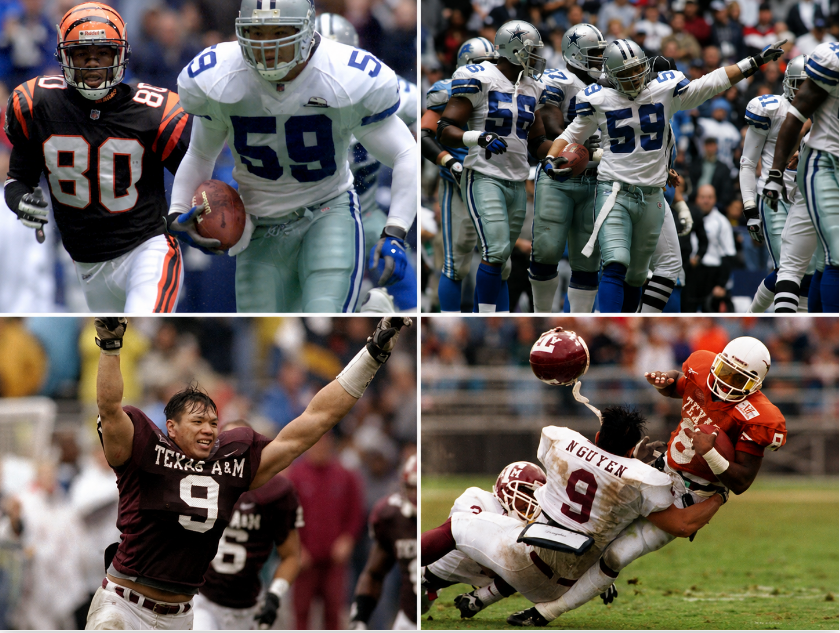
But at the absolute center of this chaotic violence stood Dat Nguyen. Opposing quarterbacks thought they could exploit his smaller frame. Big mistake. Let’s review his Dat Nguyen career retrospective right now. He acted as the ultimate field general, reading offensive guards like cheap comic books. He won the Lombardi and Bednarik awards in 1998 because he was simply smarter, faster, and meaner than everyone else on the turf.
He spent dark, lonely hours in the film room, grinding tape until his eyes bled so he could call out the opposition’s plays before the center even touched the ball. Master your playbook like Dat. One legendary practice story features Nguyen stuffing the starting running back three plays in a row, then actively telling the offensive coordinator what play he should try next. He backed up the trash talk with bone-shattering tackles that routinely stalled entire offensive drives.
Apply these real-world scenarios to your own defensive strategy:
- Read the guards: Identify the pull before the snap even happens. Offensive linemen always give away their intentions with their foot placement.
- Shoot the gap: Hesitation gets you benched. The Wrecking Crew didn’t wait for the play to develop; they blew it up in the backfield.
- Punish the ball carrier: Tackle through the man, not to him. Force the opponent to dread the next down.
- Communicate aggressively: A silent defense is a dead defense. Dat Nguyen ran the field like a military commander orchestrating an ambush.
These core principles turned Wrecking Crew defense stars into college football immortals and sent dozens of them straight into the first round of the NFL draft.
Lightning in a Bottle: The Johnny Football Phenomenon
Let’s fast forward to the modern era. The Johnny Manziel freshman season hit College Station, and the entire landscape of college football, like a Category 5 hurricane. Everyone remembers the Alabama upset in Tuscaloosa. Everyone remembers him bobbling the snap, spinning away from two All-American linebackers, and firing a laser across his body to Ryan Swope. Ignore that for a second.
Think about the sweltering Tuesday practices before anybody knew his name. The internal buzz was deafening inside the locker room long before the cameras showed up. Veterans stared in stunned disbelief as this skinny kid from Kerrville scrambled around the scout team defense, tossing sidearm dimes across his body while simultaneously running full speed toward the sideline. He made elite SEC defenders look like they were running in wet cement, just to prove a point to the coaching staff that he refused to sit on the bench for another meaningless minute.
He brought pure, unscripted chaos to iconic Kyle Field games. Think about a casino high roller pushing his entire stack on black, hitting it big ten times in a row, and walking out with the house’s money. That was Johnny Football. He possessed a sheer force of personality that demanded the spotlight, ripping the traditional, buttoned-up college football script to shreds and dragging the program into the hyper-lucrative 21st century.
You want the real behind-the-scenes of Texas A&M Heisman seasons? Picture Manziel laughing in the huddle right before calling an audible that broke the brains of defensive coordinators across the country. He owned the moment. His 2012 season single-handedly funded the half-billion-dollar renovation of Kyle Field. He didn’t just win football games; he changed the architectural skyline of the university.
The Sunday Standard: Aggies Dominating the NFL
Where are Texas A&M football legends now? They collect Super Bowl rings and cash massive checks. Look at Von Miller bending the edge on Sundays, terrifying offensive tackles with the exact same ghost rush he perfected on the practice fields in Texas. Watch Mike Evans boxing out cornerbacks in the end zone for his tenth straight 1,000-yard season.
The pros draft Aggies expecting a fully assembled product. A&M breeds distinct toughness. They understand the grueling grind required to survive a 17-game season. A rookie from A&M steps into an NFL locker room with the swagger of a seasoned vet. The league completely relies on this pipeline to supply premium talent year after year.
The Weight of the Whistle: Modern Era Coaching
The pressure cooker of Texas A&M doesn’t just forge legendary players; it consumes and tests coaches at an unparalleled level. In the modern era, the expectations have skyrocketed to match the financial investment. When Jimbo Fisher rolled into town with a $75 million guaranteed contract, it was a loud declaration that Texas A&M was no longer content with moral victories. Fisher delivered legendary, top-ranked recruiting classes, proving that the Aggie brand could go toe-to-toe in the living rooms of five-star recruits against Alabama, Georgia, and Ohio State. He brought in monsters on the defensive line that mirrored the Wrecking Crews of old.
But at Texas A&M, patience is thin, and the demand for championships is absolute. The transition to Mike Elko signifies a return to foundational grit. Elko understands that you don’t win in the SEC with just flashy talent; you win in November when your guys are tired, bruised, and forced to execute in hostile environments. He is tasked with taking the modern era’s immense talent and injecting it with that old-school, Junction Boy mentality. The whistle at Texas A&M weighs a ton, and only the elite can carry it without breaking.
Keeping the Legacy Alive
Stop missing out on the real stories. The mainstream sports networks are only going to feed you the sanitized, sponsor-friendly narratives. Meanwhile, new monsters are currently sweating in the weight room at this very second, grinding out grueling reps, preparing to etch their names in stone alongside Crow, Nguyen, Miller, and Manziel.
We bring the unvarnished heat directly to your inbox. Subscribe to Texas A&M football history right now. Lock in your Texas A&M VIP alumni updates today. Grab exclusive Aggie football interviews, break down the actual game film, and get the premium Aggie sports content that casual fans completely ignore.
Test your scouting eye on Saturdays. Practice identifying these legendary traits—the footwork of the edge rushers, the pre-snap reads of the middle linebackers, the punishing blocks of the offensive tackles—the next time you watch a game, and join our hardcore community of football purists who respect the blood on the grass.
FAQs
- Who was the first Texas A&M player to win the Heisman Trophy?John David Crow won the prestigious award under the legendary coaching of Bear Bryant, setting the standard for physical play.
- What made the Wrecking Crew defense so dominant?Relentless film study, violent tackling, and an intimidating locker room culture led by field generals like Dat Nguyen.
- Where can I find updates on current Aggies playing in the NFL?Join our VIP community for weekly pro-player breakdowns, exclusive alumni spotlights, and behind-the-scenes stories.