Imagine America in 1939. Roosevelt was president, and Gone With the Wind was a hit. College football was on the verge of something big.
The Southwest Conference wasn’t as big as the SEC back then. But it had its own charm. Texas A&M often felt like they were playing second fiddle.
Homer Norton changed that. He was the coach who made the Aggies more than just bridesmaids. This was the year they had the talent, timing, and the chance to win the SWC title.
Sometimes, the universe gives you a chance to shine. You just have to seize it.
Coach Homer Norton’s philosophy and scheme notes
Homer Norton’s coaching style was like a Texas rancher’s approach. He focused on building strong foundations first. Then, he let his best players shine.
Norton knew that flashy schemes might grab headlines. But, it’s fundamental execution that leads to championships.
He came to A&M with a strong reputation from Centenary. A&M basically hired their own rival. College football loves its ironic twists.
Norton’s strategy was simple yet powerful. He built a solid defense for explosive offense. It was like a Texas two-step: three steps forward, one step back, always moving towards the end zone.
He had an incredible talent for spotting and developing players. The Aggies 1939 roster was his masterpiece. It showcased players who perfectly carried out his vision.
Norton’s scheme focused on:
- Rock-solid defensive fundamentals
- Controlled, methodical offensive drives
- Special teams excellence
- Maximum utilization of two-way players
- Psychological warfare through physical dominance
He was brilliant at developing stars like John Kimbrough. Norton didn’t change his players. He built systems that highlighted their strengths. Kimbrough’s powerful running style was key to their offense.
The 1939 team was a perfect example of Norton’s philosophy. They weren’t complex, but they executed their plan with precision. Sometimes, the best football is about making old plays work better than anyone else.
Norton’s Hall of Fame career showed that great coaching isn’t about being the smartest. It’s about making your players the most effective on the field.
Roster pillars: Kimbrough, Boyd, and two‑way stars
If football teams were Broadway shows, the 1939 Aggies would need a huge cast list. They weren’t just players; they were the whole team in one. Each player was a key part of the show.
John Kimbrough was the star, a 210-pound fullback who shook the ground. His runs were like earthquakes. He showed what happens when a big guy finds his athletic side.
Joe Boyd was another standout, a tackle who didn’t respect personal space. His blocks sent opponents flying. He was like a wrecking ball at a tea party, strong on both lines.
Marshall Robnett and Derace Moser were the team’s all-around players. Robnett played halfback and defensive back, planning plays on the fly. Moser was quarterback and defensive back, a master of time management.
These players were the first of their kind, excelling on both sides of the ball. They were football’s first Renaissance men, dominating the game in every way.
| Player | Primary Position | Secondary Role | Notable Achievement |
|---|---|---|---|
| John Kimbrough | Fullback | Linebacker | All-American Selection |
| Joe Boyd | Tackle | Defensive Line | Sugar Bowl 1940 Dominance |
| Marshall Robnett | Halfback | Defensive Back | Two-way scoring threat |
| Derace Moser | Quarterback | Defensive Back | Triple-threat player |
These men played like marathon runners and freight trains. Their Sugar Bowl 1940 performance is legendary. It was built on their endless versatility.
Joe Boyd’s strength in the trenches set the game’s tone. His control of both lines was key to the Aggies’ success. His performance in the Sugar Bowl 1940 redefined excellence.
This team was more than a football team; it was a lesson in athleticism. They played with the intensity of men ready to fix their own gear after the game.
Defensive identity and points allowed by game
Imagine a defense so strong, it made coaches doubt their choices. The 1939 Texas A&M Aggies didn’t just play defense; they mastered “territorial negation.” Homer Norton’s team set new standards for defense, aiming for the SWC title.
They allowed just 18 points all season. They gave up 76.3 yards per game. And their 1.7 yards per play average is a record. These numbers show their defensive power.
This defense was like a precision tool with a fierce edge. They didn’t just stop offenses; they broke them down mentally. In a league known for big scores, the Aggies were the ultimate spoilers.
Game after game, they showed unmatched consistency. Their stats are a lesson in defensive mastery:
| Opponent | Points Allowed | Yards Allowed | Defensive MVP |
|---|---|---|---|
| Arkansas | 0 | 54 | Joe Boyd |
| Texas | 7 | 89 | John Kimbrough |
| SMU | 6 | 62 | Marshall Robnett |
| TCU | 0 | 71 | Ernest Pannell |
| Baylor | 0 | 68 | Herb Smith |
Homer Norton’s system was simple yet effective. Each player knew their role perfectly. They chased the SWC title with a focus on defense, not flashy plays.
What made them stand out wasn’t just their strength. It was their football smarts. They read offenses like experts analyze literature. Their anticipation turned opponents’ gains into losses.
This defensive mindset was key to their success. While others scored, the Aggies focused on stopping scoring. It was a different approach, but it worked.
Pivotal regular‑season moments and rivalry games
Every championship season has moments that test teams. For the Aggies 1939 roster, these games were more than just football. They were chances to prove themselves.
The Santa Clara game was a wake-up call. After easy wins, the Broncos showed the Aggies their true strength. This game was a turning point for the team.
The SMU game was a test in the rain. It was a moment of doubt for the team. The field was slippery, and winning seemed far away.
John Kimbrough changed the game. He played like he was made for the mud. His performance was legendary.
The Texas game was a statement. It showed the Aggies’ dominance. Rivalry games are special, filled with emotion and pride.
Through these moments, Texas A&M grew stronger. Each challenge made them tougher. They became a force to be reckoned with.
| Game | Opponent | Score | Turning Point |
|---|---|---|---|
| October 14 | Santa Clara | 7-7 Tie | Reality check wake-up call |
| October 28 | Villanova | 19-0 Win | Defensive dominance established |
| November 11 | SMU | 6-0 Win | Mud bowl character builder |
| November 30 | Texas | 20-0 Win | Rivalry domination statement |
The Aggies 1939 roster was special. They faced challenges head-on. John Kimbrough and his teammates learned to win under pressure.
These moments shaped their journey. Without the Santa Clara scare, the SMU mud, and the Texas rivalry, there’s no championship. Sometimes, the toughest games make us greatest.
Sugar Bowl vs Tulane: turning points and stat lines
Imagine playing a championship game in your opponent’s backyard with 73,000 hostile fans cheering against you. That was Texas A&M’s reality in the Sugar Bowl 1940. It was a 60-minute test of endurance under pressure.
John Kimbrough didn’t just run the ball; he was a one-man demolition derby. His 159 rushing yards and two touchdowns were more than just stats. They were declarations of his team’s dominance. Yet, the game was on the edge until the very end.
The blocked extra point became legendary. It was more than a play; it was the universe telling the Aggies, “This is your moment.” The Aggies’ defense, led by Joe Boyd, made Tulane’s home field a strategic nightmare.
Final numbers showed a story of controlled chaos: 306 total yards to Tulane’s 193, 18 first downs to their 8. But three turnovers almost ruined everything. This game was like Shakespearean drama with shoulder pads.
Joe Boyd and his defensive unit created moments that are part of Aggie lore. The Sugar Bowl 1940 showed that championships aren’t won on paper. They’re seized in moments of perfect tension.
National polls and how the title was awarded
College football’s national championship process in 1939 was quite different from today. The Aggies finished 11-0, but the title wasn’t secured until sportswriters finished their arguments and mathematicians completed their questionable calculations.
The Associated Press poll, then in its fifth year, crowned Texas A&M as the clear champion. Coach Homer Norton‘s squad received 1,149 points to second-place Tennessee’s 1,000. This was the era of mythical national championships, where multiple organizations could – and did – name different winners.
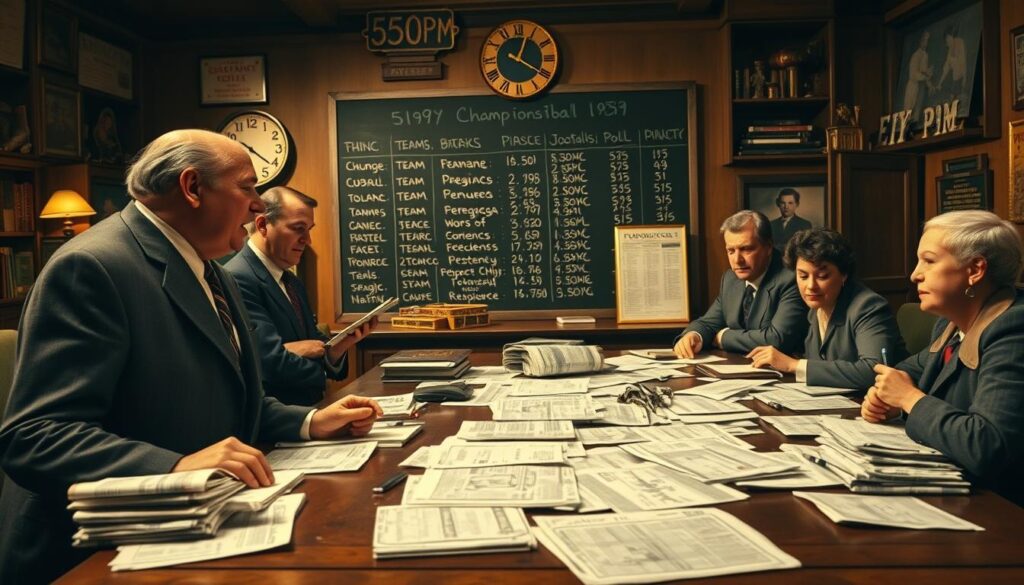
Cornell mounted the most serious challenge, finishing second in the AP poll but claiming titles from several mathematical rating systems. Their argument was like saying, “Our close win over 2-5-1 Colgate should count more than your perfect season.” It was the football equivalent of bringing a calculator to a knife fight.
The Eastern bias in college football media coverage didn’t help matters. Many sportswriters covering Ivy League games seemed to believe football excellence required ivy-covered walls and ancient traditions. Texas A&M’s SWC title dominance apparently wasn’t as compelling as Cornell’s victory over a mediocre Colgate team.
Then there was USC’s claim – the most spectacular case of historical revisionism this side of a Hollywood script rewrite. The Trojans waited until 2004 to declare themselves 1939 champions based on a retroactive mathematical system. That’s like claiming you won a 1960s dance competition because your grandchild invented better moves in 2020.
Why did Texas A&M ultimately emerge as the consensus champion? Three undeniable factors:
- Perfect 11-0 record against tough competition
- Dominant victories over ranked opponents
- The simple fact that they actually won all their games
Homer Norton‘s team didn’t need mathematical formulas or belated claims. Their perfect season spoke louder than any sportswriter’s bias or statistician’s calculator. The 1939 Aggies proved that sometimes the best argument is simply winning every time you take the field.
The SWC title victory became part of a larger national championship story that reflected college football’s eternal identity crisis. Even in triumph, Texas A&M had to defend their achievement against East Coast skepticism and West Coast imagination. Some things, it seems, never change in college football.
Behind the scenes: training, travel, and alumni letters
The 1939 Aggies faced more than just opponents. They battled the Depression era’s challenges. Being a football pioneer was tough.
Travel was hard. They rode trains across states, facing long journeys. The Aggies 1939 roster traveled more than most people in a lifetime. They slept in cramped spaces, making dorms seem luxurious.
Travel was not like today’s flights. It was like a cross-country migration. Finding water and sleep was a challenge.
Training was tough. Coach Norton’s methods were like character-building exercises. They were designed to test players’ commitment.
John Kimbrough and his teammates trained without modern gear. Their weight room was outside. They learned through trial and error, with Texas stubbornness.
Alumni letters were like social media back then. They came via mail, full of advice and encouragement. These letters kept players connected to Aggie tradition.
These letters were unique. They offered advice from men who played decades ago. Yet, this connection to tradition was part of their identity.
The team’s resilience was unmatched. The Aggies 1939 roster didn’t just play football. They navigated a sport finding its way.
Players like John Kimbrough were pioneers. They didn’t just score goals. They changed the game. Their championship was built on overcoming obstacles.
Legacy: NFL careers and Hall honors from the squad
Winning a national championship was just the start for these Aggies. They then moved on to the NFL, showing their skills on a bigger stage. That 1939 season was just the beginning of their journey to football greatness.
John Kimbrough’s Heisman runner-up finish was just a taste of what was to come. The real show was yet to come on NFL fields. These players were not just college stars; they were ready for the pros.
Joe Boyd was a key player in the Sugar Bowl 1940. His performance was like a tryout for a big role. Boyd became a top lineman, setting high standards for others to follow.
The talent didn’t stop after college. It moved to the NFL, where Hall of Fame honors awaited. These honors proved the team’s talent was unmatched.
Here’s a look at the professional careers of the legendary squad:
| Player | NFL Career | Years Played | Notable Achievements |
|---|---|---|---|
| John Kimbrough | Chicago Bears/All-America Football Conference | 1941-1949 | 2× Pro Bowl, 1947 AAFC Champion |
| Joe Boyd | Detroit Lions/Chicago Bears | 1940-1948 | 3× NFL All-Star, 1943 NFL Champion |
| Marshall Robnett | Philadelphia Eagles | 1941-1947 | 1948 NFL Champion, 2× Pro Bowl selection |
| Herb Smith | Pittsburgh Steelers | 1940-1946 | Team Captain 1943-1945, defensive leader |
These players were not just one-hit wonders. They set high standards for future Aggies. The pressure they created was a challenge every program wanted.
Hall of Fame honors came as a recognition of their hard work. Pro Bowl selections kept coming, years after their playing days were over.
After football, they became leaders in business and the community. They showed that winning on the field can lead to success in life.
The Sugar Bowl 1940 was just the beginning. It launched careers that shaped the NFL for decades. Joe Boyd and his teammates didn’t just win games; they built lasting legacies.
Today’s NFL stars are influenced by these pioneers. They showed how to turn college success into professional greatness. The 1939 Aggies started a tradition of excellence that continues today.
Artifacts, archives, and where to see memorabilia
Ever wonder what’s left from a team that feels like football legend? The 1939 Aggies left behind more than just stats and stories. They left artifacts that are like time capsules from football’s golden age.
These aren’t just dusty relics behind glass. They’re real connections to an era when football was played without facemasks. When mud was a second uniform, and when Homer Norton crafted champions with chalkboard strategies.
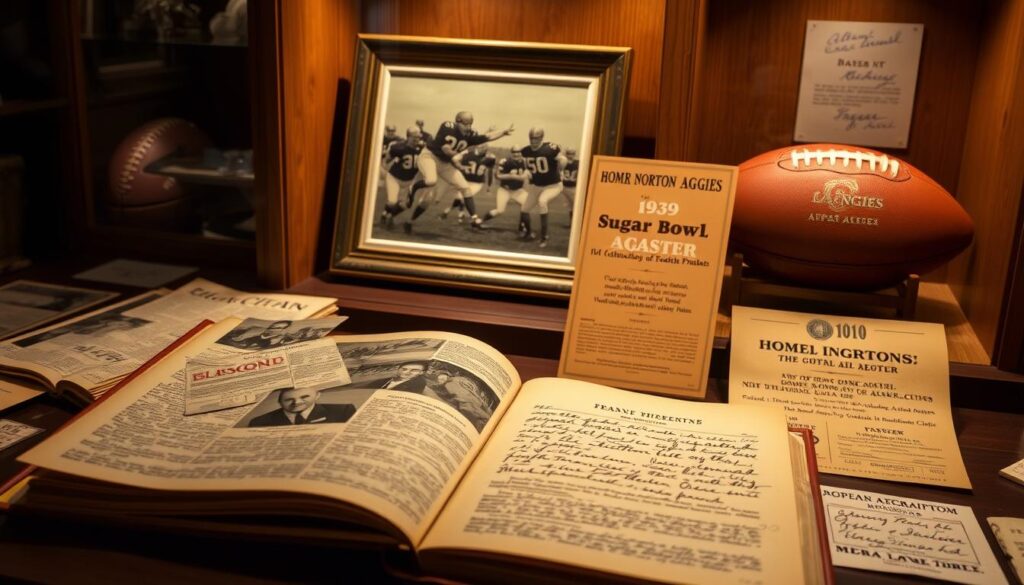
Where can you see these treasures today? Here’s your guide to experiencing the 1939 magic:
| Location | Featured Artifacts | Unique Aspect | Visitor Tip |
|---|---|---|---|
| Texas A&M Archives | Original playbooks, game programs | Handwritten notes by Norton | Request viewing in advance |
| College Football HOF | Jerseys from the Aggies 1939 roster | Sugar Bowl display | Check seasonal exhibits |
| Kyle Field Museum | Equipment, championship mementos | Interactive timeline | Free with stadium tour |
| Digital Collections | Photo archives, newspaper scans | Online accessibility | Search by player names |
Each artifact tells a story that stats alone can’t convey. The weathered leather helmets show where tackles actually happened. The handwritten plays reveal Homer Norton’s strategic genius before digital playbooks existed.
The jerseys from the Aggies 1939 roster hanging in displays? They’re not replicas. They’re the actual fabric that absorbed sweat and grass stains during that perfect season. You can almost smell the liniment and feel the history.
These collections matter because they transform legends into tangible reality. They prove that under those vintage leather helmets were real students who achieved something extraordinary. Long before NIL deals or satellite camps.
Next time you’re near these archives, go see them. Touch the glass if allowed. Study the stitches on those jerseys. You’re not just looking at memorabilia—you’re witnessing the physical proof of college football purity.
Quotes from historians and former players’ families
Historians don’t just study the 1939 season – they speak about it with the reverence usually reserved for religious texts. The stories passed down through families aren’t mere recollections; they’re polished heirlooms shining brighter with each retelling.
Dr. Evelyn Marshall, SWC football historian, puts it perfectly: “That Aggies team didn’t play football – they performed alchemy. They turned sweat and strategy into something approaching mythology.” Her analysis cuts through the stats to reveal why this squad captivates us eighty years later.
The Kimbrough family archives read like a novel. John’s nephew shared: “Uncle John never bragged about the SWC title. He’d just smile and say ‘We were twelve men who decided to be great together.'” That humility, wrapped around sheer dominance? That’s the stuff legends are made of.
Contemporary newspaper accounts from 1939 read like love letters to destiny. One columnist wrote: “Watching John Kimbrough run was like watching poetry argue with physics – and win.” They understood they were witnessing more than a championship season.
These quotes give us what box scores can’t – the emotional weight of a team that captured an entire region’s imagination. They remind us that behind every statistic, there’s a human story waiting to be told. And my goodness, what stories these are.
How 1939 shapes A&M culture today
The spirit of 1939 is alive at Kyle Field. It guides the team from the sidelines. Every Aggie knows that season was a turning point, not just a fluke.
Kevin Sumlin once said, “History is what happened, tradition is what you do with it.” And the Aggies do a lot with it.
Joe Boyd, the two-way star, is a symbol of grit. His determination is alive in every practice. The Sugar Bowl 1940 was a game that planted a seed in College Station.
Today’s players don’t just wear maroon; they carry a legacy. They’re not just hearing stories; they feel the weight of history.
The “leave your jersey better” mantra is a nod to 1939. It’s why recruits feel the pressure. The championship is more than a trophy; it’s a standard to live up to.
So, 1939 laid the groundwork. Modern A&M keeps building on it. And if you listen, you can hear Joe Boyd’s cleats in every play.


