Imagine college football’s biggest underdog story, but with a twist. The underdog just lost to their biggest rival. That was the wild excitement of the 1998 Big 12 Championship.
Bill Snyder’s Kansas State Wildcats were on a roll. They were beating teams with ease, like a villain in a James Bond movie. They won 19 games in a row, with an average win margin of 49-11. Being ranked #2 seemed like a given.
On the other hand, Texas A&M arrived in St. Louis feeling out of place. They had just lost to Texas and were starting a backup quarterback. The story was already written.
The stage was set for Bill Snyder’s big win. But, as they say, when things seem too perfect, trouble is lurking.
Game script: early deficits and momentum swings
The first half was like a bad sports movie remake. Kansas State started strong, while Texas A&M seemed off. It was like they forgot their gloves.
Michael Bishop played like a video game character with cheat codes. He was 8-for-8 passing for 159 yards and two touchdowns. His 66-yard pass to Darnell McDonald was a big hit before halftime.
The Aggies’ offense was slow, like a dial-up modem. Branndon Stewart missed his first five passes. At halftime, A&M was down 17-6, with only two Russell Bynum field goals.
Then, a big change happened. News of UCLA’s loss came, like a twist in a thriller.
The field’s energy shifted. Kansas State players played not to lose. Texas A&M saw they had nothing to lose. The momentum swing was clear, a rare sports moment.
Football momentum works like the stock market. It’s not always logical but can change everything. The Wildcats were like blue chips all game. Then, they looked like a meme stock ready to crash.
This momentum shift changed the game’s feel. The team that dominated looked weak. The struggling team found new life. It was like seeing a heavyweight champ get wobbled.
The TWA Dome felt different, from celebration to tension. What seemed like a sure Kansas State win was now anyone’s game. The second half would show who could handle the emotional ups and downs.
Turning points: special teams, blitz packages, takeaways
Every legendary collapse has its key moments. These are the plays where you can see the momentum shift right before your eyes. For Kansas State, it was that hard hit that turned their game plan upside down.
Warrick Holdman’s hit on Bishop was more than just a tackle. It was a statement. The Aggies’ “Wrecking Crew” defense launched a perfect blitz. This forced a fumble, picked up by Cornelius Anthony at the Wildcats’ 35-yard line. It was like pulling the emergency brake on a speeding train.
While the fumble got all the attention, Dat Nguyen’s performance was relentless. He made 17 tackles, setting a Big 12 championship game record. He was everywhere, like a Terminator programmed to hunt Wildcats.
The Aggies’ blitz packages became more precise with each play. What started as occasional pressure turned into targeted attacks on K-State’s line. Each successful blitz piled on, leading to a snowball effect of defensive dominance.
Kansas State’s special teams, usually reliable, became a problem. Missed chances and poor field position made every yard a struggle.
But the real story was in the penalties. Thirteen penalties for 110 yards showed a team cracking under pressure. It was like watching someone realize they’ve left the stove on, leading to panic.
| Defensive Stat | Texas A&M | Kansas State | Impact |
|---|---|---|---|
| Forced Fumbles | 2 | 0 | Critical momentum shifts |
| QB Pressures | 15 | 6 | Disrupted offensive rhythm |
| Penalty Yards | 45 | 110 | Self-inflicted wounds |
| Third Down Stops | 8 | 4 | Sustained defensive dominance |
These turning points were connected, creating a domino effect. Each successful blitz package made the next one more effective. Each penalty made the next mistake more likely. The Aggies didn’t just beat Kansas State—they dismantled them.
The special teams battle became key as the game went on. A&M’s coverage units gave them field position advantages, putting the Wildcats on the back foot.
In the end, these moments were more than just plays. They were psychological blows. Each takeaway, each successful pressure, each penalty flag eroded Kansas State’s confidence until they were left with doubt and desperation.
OT sequences and Parker’s legendary route
Third-and-seventeen in double overtime is like a big crisis. Most coaches would choose to punt and hope for the best. But Texas A&M decided to take a big risk with a bad hand.
Kansas State had just run four times for 17 yards. They kicked a field goal to lead 33-30. Most would say to play it safe and go to third overtime. But Sirr Parker had other plans.
The play call was bold: a pass when everyone else wanted to run. Parker’s slant route was meant to break the rules. He took off fast, leaving Luke Butler in the dust.
Then, something magical happened. Parker caught the pass at the 15-yard line. He dodged Lamar Chapman and sprinted towards the pylon. His finish was like a punctuation mark.
Three things made this play legendary:
- The audacity: Calling a pass on 3rd-and-17 in OT
- The executionParker’s route precision and yards-after-catch explosion
- The stakes: National championship implications on the line
This play wasn’t just a win. It made Sirr Parker a legend in Aggie history. When he scored, he changed destiny.
Coaching decisions and clock management
Coaches make decisions that can win or lose games. The 1998 Big 12 Championship showed this clearly. R.C. Slocum and Bill Snyder had different ways of thinking.
Slocum’s choice to go for two after a touchdown was bold. It showed he was all in. With just 1:05 left, most would have kicked the extra point. But R.C. Slocum knew about the power of momentum.
The two-point conversion was a big moment. It was a result of trusting his players all season. Slocum was playing to win, not just to not lose.
Bill Snyder’s clock management was questioned. The Wildcats had a chance to win in regulation. Martin Gramatica was set to kick a 69-yard field goal. But a delay-of-game penalty changed everything.
This moment showed the importance of staying focused:
- Preparation meets opportunity
- Discipline under duress
- The thin margin between genius and goat
Snyder’s cautious approach was different from Slocum’s boldness. In big moments, coaches show their true selves. The penalty was a big mistake, showing a lack of confidence.
These final minutes were a test of leadership. Slocum’s risk paid off because he trusted his team. Snyder’s caution failed because it was driven by fear. In high-pressure games, your coaching style is revealed.
Player spotlights: Randy McCown, Dat Nguyen, Parker
College football has a magic that turns unknown players into stars in no time. The 1998 Big 12 Championship was more than a game. It was a place where legends were born, thanks to heroes, small but mighty warriors, and one unforgettable catch.
Branndon Stewart started off shaky, with only 4 completions for 89 yards. But in the fourth quarter, he transformed into a quarterback to remember. He threw 9-of-16 for 185 yards and scored two touchdowns that seemed impossible.
His final stats were impressive, with 324 passing yards. This was a huge turnaround from being the second-best quarterback on his team earlier. It’s a perfect example of sports irony.
Dat Nguyen, a 5’11” linebacker, played like a giant. While everyone watched the quarterbacks, Nguyen dominated with 17 tackles. He was like a doctor diagnosing offenses.
Sirr Parker, a 5’7″ backup running back, made history with a game-winning catch in overtime. His catch was more than a play; it was a moment that changed everything. It showed that sometimes, it’s one moment that defines a career.
Michael Bishop had incredible stats, with 324 passing and 101 rushing yards. But he’s mostly remembered for a fumble. It’s like writing a great book and being remembered for a small mistake.
| Player | Position | Key Stats | Defining Moment |
|---|---|---|---|
| Branndon Stewart | QB | 324 pass yards, 2 TD | 4th quarter transformation |
| Dat Nguyen | LB | 17 tackles | Defensive dominance |
| Sirr Parker | RB/WR | OT game-winning TD | Legendary catch |
| Michael Bishop | QB | 425 total yards | Crucial fumble |
What makes these performances special is the drama they bring. Stewart, Nguyen, Parker, and Bishop each had their own story. They showed that in college football, anyone can become a legend.
These players weren’t just athletes; they were characters in a grand story. Twenty-five years later, we’re all talking about their moments.
Broadcast memories and fan accounts from St. Louis
Some sports moments are more than just games. They become part of our culture. The 1998 Big 12 Championship was one such moment.
ABC’s Brent Musburger and Dan Fouts were more than just announcers. They were telling a story of drama. When Sirr Parker scored, Musburger’s voice showed his amazement.
The TWA Dome was like a big experiment. Kansas State fans went through all the emotions. They felt denial, anger, bargaining, depression, and then acceptance.
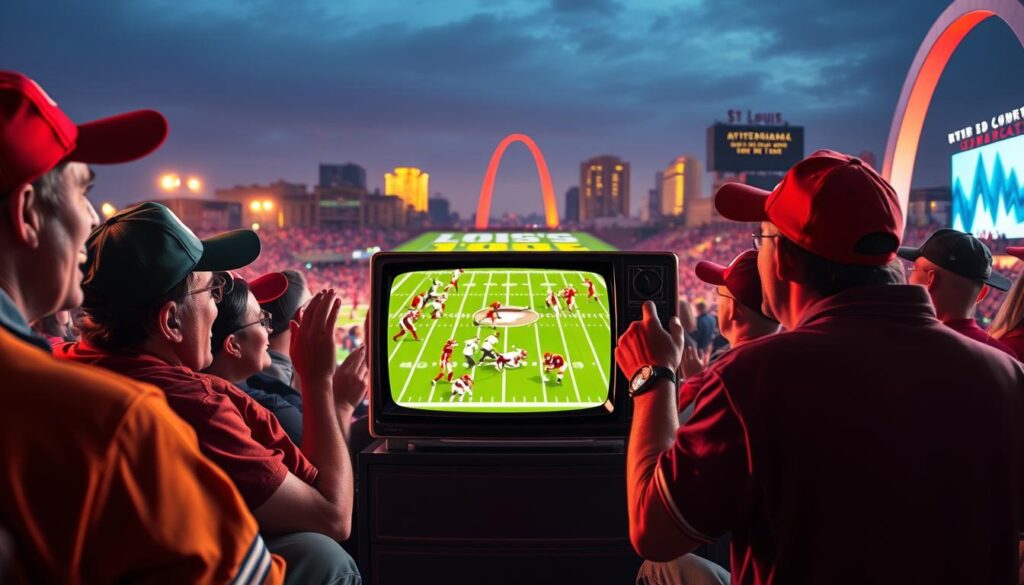
Aggie fans, on the other hand, felt hope. They celebrated with a chant that was more than just cheers. It was a way to heal from past disappointments.
These fan accounts are like our shared history. They tell stories of strangers becoming friends and families planning around the game. Students even skipped school to watch history unfold.
The broadcast was more than background noise. It captured the essence of the game. When Musburger’s voice cracked, he was marking a moment in history.
That night in the TWA Dome was unforgettable. It showed us that sports are unpredictable. And that’s why we love watching them.
Bowl ramifications and national aftermath
Welcome to the BCS era, where algorithms ruled over athletic directors. One November night could change an entire season. Kansas State’s collapse showed college football’s true nature: a numbers game.
The Wildcats fell from national title hopes to the Alamo Bowl. It was like watching a luxury yacht sink while a rowboat passed by. Texas A&M, on the other hand, got their first BCS bowl spot in the Sugar Bowl. It was a big upgrade.
Bowl committees showed their true colors after. The Cotton and Holiday Bowls ignored K-State. The Alamo Bowl, though, offered them a chance to face Purdue. It was clear: win and you’re a king; lose and you’re in San Antonio.
Michael Bishop’s Heisman finish was like a participation trophy. Finishing second after a big loss felt like being the second-most attractive at a reunion. It’s an achievement, but you wanted first.
The BCS era math was always right. You’d plan for a national title, then measure curtains for the Alamodome. For Texas A&M, the Sugar Bowl meant Ohio State instead of a warm welcome. It was a reality check.
Where the win ranks in program history
Choosing the best Aggie football wins is hard, like picking your favorite child. But after 100+ years, the 1998 Big 12 Championship is often in the top three. It’s like hitting a grand slam while blindfolded.
The Aggies won their first conference title in 1998, beating Kansas State. This win was huge, as it was the first for the Aggies in years. It was a big upset for a team known for close losses.
The Aggies came back 15 points to tie a school record. But this win was special because of the team they faced and the quarterback. It was a moment of redemption and validation.
So, where does this win rank? Some might say the 1939 national title is the best. Others might choose the 2012 Alabama upset for its cultural impact. But for perfect storytelling, the 1998 win is unmatched.
This game is legendary for Aggie fans, told to their grandkids. It’s the story of a big win, not just another close loss. It’s the night the Aggies proved they could win the big game.
Alumni check‑ins: careers after ’98
Ever wonder what happens after the confetti settles and the trophy gets dusty? The 1998 Big 12 Championship wasn’t just a game—it was a career launching pad for some and a lifetime peak for others. Let’s check the receipts on where these legends landed.
Dat Nguyen’s performance that night was like watching a defensive tutorial. He didn’t just win the game—he collected the Lombardi and Bednarik awards like they were trading cards. The most decorated player in A&M’s Big 12 history? That’s not just hype—that’s fact.
His NFL career with the Dallas Cowboys proved college greatness could translate. Seven seasons, 516 tackles, and the respect of every offensive coordinator who had to gameplan against him. Not bad for an “undersized” linebacker everyone doubted.
Then there’s Michael Bishop—the ultimate “what if” story. The man was a human highlight reel at K-State, but the NFL career never quite materialized. He got drafted by the Patriots, bounced around practice squads, and eventually became a CFL star. Sometimes college greatness is just that—college greatness.
Sirr Parker’s 32-yard OT touchdown became his football epitaph. Brief NFL career stints with the Chargers and Raiders, some CFL action, but that moment in St. Louis? That’s the clip they’ll show at his funeral. And honestly, what a clip to have.
| Player | College Accolades | Professional Career | Legacy Status |
|---|---|---|---|
| Dat Nguyen | Lombardi/Bednarik winner | 7 NFL seasons (Cowboys) | Program legend |
| Michael Bishop | Heisman finalist | Practice squads/CFL | Cult hero |
| Sirr Parker | Championship hero | NFL/CFL journeyman | One-play immortal |
Here’s the brutal truth about college football: for every Dat Nguyen who parlays success into a long pro career, there are ten Michael Bishops and Sirr Parkers. Their peak moment happened before they could legally rent a car. That championship game wasn’t just a game—it was the dividing line between career launchpads and lifetime achievements.
These men walked off that field not knowing they’d just experienced the highlight of their athletic lives. Some built on it. Some never topped it. That’s the beautiful, cruel poetry of college football—it gives you moments that either become stepping stones or become your entire story.
Tactical lessons from the comeback
The Wrecking Crew was more than a nickname—it was a battle plan under fire. Unlike others, A&M’s defense played a game of 3D chess. They used blitz packages that would impress Sun Tzu.
They believed in constant pressure to create chances. When K-State thought they had the game won with 3:26 left, the defense acted like a jazz musician. Sometimes, the best moves are those you feel, not just plan.
What made the Wrecking Crew stand out wasn’t just skill—it was their awareness. They knew momentum is real and can be used with bold moves. Coaches learned that sometimes, you need to ditch the playbook and let players play.
The true brilliance was in understanding psychology. Desperation sparks creativity, while comfort breeds complacency. Betting against a desperate team is like facing a gun with a knife—you might look ready, but you’re at a disadvantage.
Archival resources and how to rewatch
Want to see this legendary game for yourself? The full game is saved in digital archives. Brent Musburger’s famous call of Parker’s game-winning moment is there. ABC’s broadcast with Musburger and Dan Fouts is the best way to see this overtime thriller.
Sports archives and college football history collections keep this classic safe. It’s often included with other historic games, like the Criterion Collection of college football classics. Watching it now, you’ll notice details you missed the first time.
The tension on Kansas State’s sideline is clear now. Stewart’s body language tells a story. You’ll see the moment hope returned to the Aggie bench, just like spotting clues in The Sixth Sense.
This isn’t just a game. It’s a lesson in how stories can change. Every small moment is important. Knowing the end makes the game even more exciting.
Look for it on major sports archives. The quality is surprisingly good. Musburger’s voice is as captivating as ever. This game is a must-see for football fans.