Let’s be honest. The most prestigious individual trophy in sports often ends up as a very expensive dust collector.
Heisman winners like Matt Leinart, Sam Bradford, and Carson Palmer have confessed their bronze idols live in closets, storage rooms, or on the dining room table. It’s a bizarre comedy—the pinnacle of achievement, tucked away like a family secret.
But what happens when we shift the lens from the individual to an entire program? When we talk about Aggie football awards, we’re not just ticking boxes on a Wikipedia page.
We’re digging into the hardware that punctuates a 125-year saga. It’s a story that starts with the 12th Man—an honor in spirit—and the 1939 national championship that announced a powerhouse.
This isn’t a dry list. It’s an archaeological dig into a legacy built on grit and innovation. It sets the stage for the specific plaques and trophies that define a culture, including recent prestigious postseason honors.
So, why do some awards shine in a case, while others gather dust? The answer is woven into the identity of the place that won them.
Feature on Outland and Bednarik winners
Let’s talk about the unsung heroes of football—the ones celebrated by the Outland and Bednarik awards. These A&M accolades often go unnoticed. They honor the defenders, not the flashy quarterbacks.
The Outland Trophy goes to the best interior lineman. It’s for the unsung hero who makes the stars shine. For Texas A&M, winning it shows their dedication to building a strong foundation.
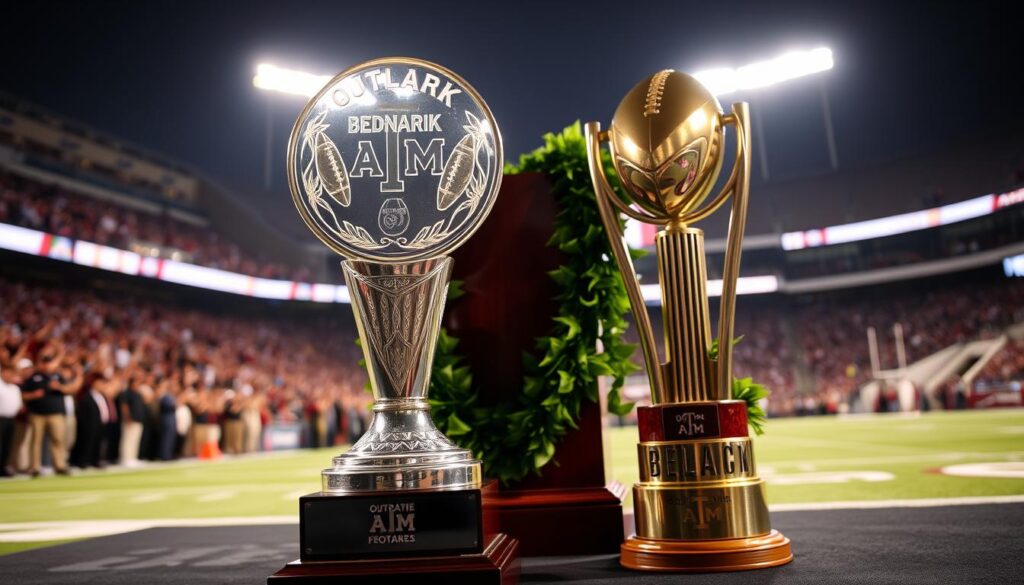
The Chuck Bednarik Award is for the defensive player of the year. Dat Nguyen, an Aggie legend, won it in 1998. His win was a statement of the team’s defensive prowess.
Nguyen’s 1998 season was groundbreaking. He won both the Bednarik and Lombardi Awards. His achievements showed that a defense-first approach can lead to greatness.
The Outland and Bednarik awards show two sides of Texas A&M’s football identity. The Outland is about hard work and line play. The Bednarik is about making a lasting impact.
These awards highlight Texas A&M’s defensive strength. They show that the team values stopping touchdowns over scoring them. It’s a testament to the power of defense.
Reactions from players/coaches
Award trophies tell one story, but the real stories are in the reactions of winners. These are not just thank-you speeches or nods to the committee. They are the raw, unfiltered feelings that show a team’s true spirit.
Gene Stallings remembered Bear Bryant’s Junction Boys camp as “I wanted to die.” This wasn’t a complaint but a sign of the toughness that made the team strong. Stallings didn’t just survive; he was shaped by it. The team’s response to Bryant’s tough training was to embrace it, leading to a Heisman winner in John David Crow.
Jackie Sherrill created the 12th Man Kickoff Team for more than just special teams skills. It was about building a philosophy. He wanted students and walk-ons to volunteer for tough tasks. This tradition is the real award, turning reaction into a lasting ritual.
Jimbo Fisher’s coaching is all about pushing against modern ease. His motto, “Do it til you get it right”, is about hard work. He focuses on small details, making players react to every aspect of their game. This approach builds winners by focusing on the process, not just the outcome.
The 1967 Aggies were known for their simple motto: “make something happen.” This wasn’t traditional coaching but a way to build a winning mindset. By always reacting, they achieved greatness.
The Outland Trophy at A&M is more than a trophy. It’s about the hard work and dedication it represents. It’s about the early morning workouts and the tough critiques. The Outland Trophy is a symbol, but the real value is in the daily effort.
Eric Crouch’s Heisman win was a moment of personal glory. But at A&M, it’s the team’s effort that’s celebrated. The award is seen as a result of the team’s hard work. This focus on the process, not just the outcome, is how A&M builds winners. It’s a culture that values hard work and dedication.
The quest for an Outland Trophy at Texas A&M is a challenging journey. But the real prize is the mindset it builds. This mindset, shaped by adversity and high expectations, is what makes greatness possible. The reaction to the challenge is the true reward.
Impact on careers
So you win the big one. Then what? The trophy can gather dust or become a permanent prefix to your name. The career impact of a major award is a study in legacy alchemy.
Andre Ware’s Heisman is a masterclass in narrative defiance. Winning under a TV blackout is like becoming a rockstar without releasing an album. The award became his amplification, shattering racial ceilings for African-American quarterbacks. It defined his legacy and launched his post-playing career as an analyst.
For Texas A&M, Johnny Manziel’s Heisman was a cultural sledgehammer. It announced the Aggies’ SEC arrival with authority and permanently boosted the program’s national profile. The award wasn’t just personal; it was institutional.
Consider the nuanced power of a Bednarik Award. For Dat Nguyen, it wasn’t just a line on a resume. It was a lifetime credential as a defensive savant. The Bednarik crystallized his identity from “great college linebacker” to “national defensive player of the year.” That title echoes through his post-playing career in coaching and commentary.
These awards function as career capital. They open doors to broadcasting booths and speaking circuits. They define narratives as pioneer or game-changer. They cement a player’s essence in the sport’s folklore. The final question lingers. Does the award own the man, or does the man learn to wield the award?