In the early 1980s, college football was filled with teams stuck in the past. Texas A&M was one of them, searching for a spark to revive its tradition.
Then, in January 1982, a new coach arrived. He had a 50-9-1 record and was ready to shake things up. His goal was to revitalize a culture that had grown too comfortable.
The team was in a slump. It needed more than just a new strategy. It needed a complete change in how they thought and played.
The coach’s approach was unique. He mixed bold moves with strategic planning. He aimed to change the team’s mindset and the fans’ expectations. The journey to change was about to start.
Pre-Sherrill Era: Program Status
If Texas A&M football in the early 1980s were a patient chart, the diagnosis would read: chronic underachievement with acute identity crisis. The Aggies were the sleeping giant of the Southwest Conference—emphasis firmly on sleeping. This wasn’t a program in crisis so much as one in a persistent vegetative state, occasionally twitching with hope before settling back into mediocrity.
Consider the symptoms. From 1978 through 1981, the team posted a cumulative record of 20-24-1. That’s the statistical equivalent of a shrug. Coach Tom Wilson, a decent man by all accounts, presided over this era of ambivalence before receiving what the sports pages politely called “a change in direction.” Translation: he was shown the door after the 1981 season.
The real pathology manifested in rivalry games. Against Texas? The Aggies went 1-3 in those four years. Facing Arkansas? Another 1-3 mark. These weren’t just losses; they were affirmations of a pecking order where A&M consistently played the role of the also-ran. The fanbase, legendary for its loyalty, was fed a steady diet of moral victories and “wait ’til next year” platitudes.
| Opponent (1978-1981) | Games Played | A&M Wins | A&M Losses | Win Percentage |
|---|---|---|---|---|
| Texas | 4 | 1 | 3 | 25% |
| Arkansas | 4 | 1 | 3 | 25% |
| Houston | 4 | 2 | 2 | 50% |
| Baylor | 4 | 2 | 2 | 50% |
| SMU | 4 | 1 | 3 | 25% |
Look at that table. A 25% win rate against your two primary rivals isn’t a competitive landscape—it’s a surrender document. The institutional inertia was palpable. Recruiting trailed behind Texas and Arkansas. Facilities were adequate but not awe-inspiring. The program had all the ingredients of a powerhouse except the most critical one: a winning culture.
What made this era frustrating was the context. The Southwest Conference was ripe for takeover. Texas had slipped from its national dominance. Arkansas experienced its own fluctuations. Yet A&M couldn’t seize the moment. They were like a guest at a banquet who couldn’t find an empty seat, perpetually circling the table while others ate.
The fanbase’s hunger wasn’t for championships at first—that seemed like fantasy. They craved consistency. They wanted a team that didn’t follow a 9-3 season with a 4-7 collapse. They desired an identity beyond the 12th Man tradition. Was A&M a running team? A defensive powerhouse? An offensive innovator? The answer changed with the wind direction.
This was the calm before the storm, but let’s be clear: it wasn’t a peaceful calm. It was the tense, anxious quiet of unfulfilled promise. Kyle Field’s Saturdays were loud, but the echoes asked: Is this really all we are? The A&M football 1980s story was yet to be written, and the early chapters hinted at tragedy.
In retrospect, the pre-Sherrill era served a purpose. It created a vacuum—a program so thirsty for success it would drink any potion, even one mixed by a controversial, hard-charging outsider. The patient was ready for surgery. All that was missing was a surgeon willing to make the first cut.
The Hiring: Breaking New Ground
In January 1982, Texas A&M didn’t just hire a football coach. They took a bold step, hiring Jackie Sherrill with a big check. This move was a clear statement of their ambition.
The contract was huge, worth over $1.7 million. In the early 80s, this was a massive statement. It showed the Aggies were ready to win big, not just play well.
Sherrill got more than a job. He became the head coach and athletic director. This gave him total control over football operations. It was a bold move to shake things up.
This change gave Sherrill the power to make big decisions quickly. He could upgrade facilities or change the training staff without waiting. It was a bold move to break through old barriers.
The table below shows how much changed with Sherrill.
| Aspect | Pre-Sherrill Philosophy | Post-Sherrill Mandate |
|---|---|---|
| Financial Commitment | Conservative, within means | Record-breaking, market-setting |
| Coaching Role | Head Coach (Football Only) | Head Coach & Athletic Director (CEO) |
| Primary Goal | Respectability, Bowl Appearances | SWC Championships, National Relevance |
| Recruiting Stance | Regional focus, traditional methods | National ambition, aggressive tactics |
| Institutional Message | We compete with honor. | We win at any cost. |
A&M bought more than just wins with $1.7 million. They bought the freedom to dream big. They wanted to win championships and change their status.
This was a huge risk. A big contract can be a sign of greatness or a warning of failure. Sherrill was there to shake things up and bring success.
Immediate Impact: 1982-1983 Seasons
Let’s be honest. Hiring a maestro for an orchestra that’s just starting out is a big leap. Jackie Sherrill’s arrival in College Station was a shock. It was a wake-up call for a program stuck in old ways.
The early years showed a simple story. A 5-6 record in 1982 and a 5-5-1 finish in 1983. But these numbers don’t tell the whole story.
Sherrill was changing things in big ways. His Sherrill coaching style was new and demanding. It was a fresh start for the team.
He changed everything: how they practiced, worked out, and thought. The Aggies didn’t win much yet. But they had something Sherrill valued: raw spirit.
The “12th Man Kickoff Team” was a stroke of genius. In 1983, Sherrill used walk-ons to make a difference. They were students who paid their own way but gave everything on kickoffs.
This move was bold and risky. But it was also brilliant. It showed that heart and loyalty were just as important as talent.
The table below shows the early years. The wins were few, but the foundation was being laid.
| Season | Record | Key Milestone | Cultural Touchstone | Style Indicator |
|---|---|---|---|---|
| 1982 | 5-6 | System Implementation Year One | Culture Shock & New Standards | Demanding, Overhaul Focus |
| 1983 | 5-5-1 | Creation of the 12th Man Kickoff Team | Weaponizing Tradition & Walk-On Spirit | Unorthodox, Symbolic, Pragmatic |
Those seasons were just the start. Sherrill was building something strong in the shadows. His Sherrill coaching style focused on the long game, not quick fixes.
The blueprint was ready. Now, it was time to build something lasting.
The 1985 SWC Championship Team
The 1985 Aggies didn’t just climb the mountain. They took a helicopter to the top and planted their flag. This wasn’t a rebuilding year or a moral victory season. It was a game-changer for A&M football 1980s.
They finished with a 10-2 record and 7-1 in the Southwest Conference. They were conference champions. For a program that had been lost, this was a breakthrough.
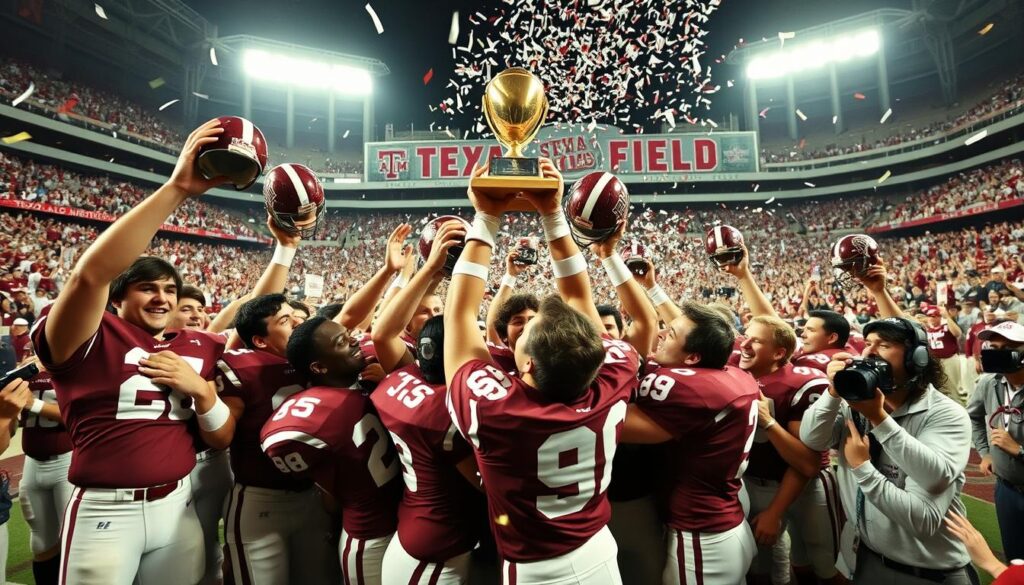
Jackie Sherrill’s system came together. It was like a complex reaction reaching its end. The defense was fierce, and the offense was unstoppable.
The Cotton Bowl was next. Auburn and Bo Jackson were waiting. The stage was set for a big win.
The Aggies didn’t just beat Auburn; they destroyed them. A 36-16 victory showed their strength. Beating a legend like Jackson on TV was a statement.
For decades, A&M was the team that almost won. But beating Auburn in a major bowl changed that. It proved they could win.
Finishing ranked #6 nationally was a big deal. It showed where they stood nationally. This season changed A&M’s identity from underdog to contender.
The 1985 SWC title was a turning point. It validated Sherrill’s vision and set the stage for more success. This was a key chapter in Texas A&M football’s story.
Recruiting Revolution and National Reach
Jackie Sherrill knew that winning isn’t just about games. It’s about building a team in living rooms. He focused on curating a culture of winners, not just filling spots.
Before Sherrill, Texas A&M missed out on top talent. The program had heart but lacked the appeal of big names. Sherrill changed this by selling transformation. He promised that coming to Aggieland would make you a champion.
The back-to-back SWC championships in 1985 and 1986 proved his point. These wins showed that Texas A&M could compete with the best. Sherrill could show recruits the scoreboard, the standings, and national rankings. “You want to win? Here’s how we win.”
This change was huge. Texas high school football is a big deal, and Sherrill wanted to be part of it. The SWC championships made Texas A&M a serious contender. Prospects had to think twice about choosing College Station over Texas or Oklahoma.
Sherrill was a master of psychology and showmanship. He knew what young men and their families wanted. It wasn’t just about NFL dreams. It was about belonging to something historic.
The Aggies’ national reach grew because of their success. Winning brought attention, and attention brought more recruits. The Aggies weren’t just a Texas story anymore. They were a national force, attracting talent from everywhere.
Look at the teams that won championships. They weren’t just from Texas. Sherrill’s vision attracted talent from all over. He built a national brand, starting with the SWC championships.
Sherrill’s legacy might be more important than his win-loss record. He showed that recruiting is the heart of a program. You can have great schemes, but without the right players, you’re just dreaming. Sherrill found the right players.
Controversial Moments and Challenges
Sherrill’s coaching style was like a high-performance engine. It was powerful, demanding, and sometimes overheated. This intensity created champions but also caused controversy.
In 1988, the NCAA found Texas A&M guilty of two years’ probation. The charges included improper employment and extra benefits. Sherrill wasn’t personally blamed, but the story is complex.
The violations were not from villainy but from a win-at-all-costs environment. Sherrill’s coaching style was about total immersion. Players became part of an ecosystem, not just a team.
Pushing boundaries too hard can lead to unexpected results. The employment violations involved players working for boosters. Extra benefits came from blurred lines between support and personal favors. These acts were not always malicious but were part of a system built on extreme commitment.
Sherrill’s resignation in December 1988 was significant. It showed that the coach and the program had become one. The NCAA found a lack of institutional control, pointing to Sherrill’s style as the controlling philosophy.
| Aspect | Sherrill’s Approach | Traditional College Model |
|---|---|---|
| Recruiting Intensity | National pursuit with aggressive timelines | Regional focus with gradual relationship-building |
| Player Development | Total immersion, year-round commitment | Seasonal focus with academic separation |
| Practice Philosophy | “Whatever it takes” mentality | Structured within NCAA hour limits |
| Program Control | Centralized under head coach | Distributed across athletic department |
| Risk Tolerance | High (competitive advantage first) | Conservative (compliance first) |
The table shows two different philosophies. Sherrill worked in gray areas, avoiding traditional models. His methods led to great results but also risks.
Sherrill’s leadership was transformative but risky. He didn’t just coach football; he changed Texas A&M. His methods had both successes and failures.
The 1988 probation was a turning point. It made everyone question the cost of winning. Today, we’re facing similar issues with NIL.
Sherrill’s legacy is complex. He modernized Texas A&M and proved Aggies could compete nationally. But he also showed how winning can lead to problems when safeguards are ignored. The controversy doesn’t erase his achievements but makes them more human and complex.
Player Development and NFL Success
Measuring a coach’s legacy isn’t just about trophies. Look at the NFL roster. Jackie Sherrill’s true genius was in creating men who excelled at the next level. The A&M football 1980s era was a real pipeline to the pros. This showed Sherrill’s reputation as a “players’ coach.”
He didn’t just gather athletes. He turned raw talent into professional players. Under Sherrill, Texas A&M produced 30 Consensus All-Southwest Conference players. This was a clear sign of dominance.
The program gained national recognition. It produced two Consensus All-Americans and two more All-American selections. These players were not just great in college; they were top prospects. Sherrill’s approach made talent soar.
It was a cultural shift. A&M became a top destination for kids dreaming of the NFL. Sherrill’s recruits didn’t fade after college; they made it to the NFL.
Here are a few key players who made the jump from Kyle Field to the NFL. They show the direct link between Sherrill’s program and NFL teams.
| Player | Position | Key A&M Accolade (Sherrill Era) | NFL Destination |
|---|---|---|---|
| Johnny Holland | Linebacker | Consensus All-American (1986) | Green Bay Packers (2nd Round, 1987) |
| Keith McAfee | Running Back | Consensus All-SWC | New Orleans Saints (1988) |
| Kevin Murray | Quarterback | All-SWC, School Record Holder | Dallas Cowboys (Supplemental Draft, 1984) |
| Sammy O’Brient | Defensive Back | All-SWC Selection | Houston Oilers (1987) |
This pipeline did more than just get players drafted. It boosted the Aggie brand. High school stars could see a clear path. Come to A&M, develop under Sherrill, dominate the SWC, and get your shot at the league. It’s a compelling pitch.
The A&M football 1980s story has two strands. One is championships and rankings. The other is the steady stream of NFL talent. Sherrill didn’t just build a winning team; he built a professional factory. The wins made headlines, but the careers built men and defined a lasting legacy.
Coaching Staff and System Changes
Great generals need great lieutenants. Jackie Sherrill knew this well. His talent wasn’t just on the field. It was in building a team of experts.
At Pitt, he had Jimmy Johnson and Dave Wannstedt. Both became NFL head coaches. At Texas A&M, he did the same. He didn’t just hire coaches; he found innovators.
Sherrill also changed the team’s philosophy. He updated the Aggies’ plays, making them more modern. This was a big change, not just in plays.
He had the right vision and team. His staff brought the tactical skills. Together, they dominated the Southwest Conference.
The three SWC championships from 1985-1987 were not random. They showed the power of Sherrill’s team. The real legacy was the system and staff that made Texas A&M a football powerhouse.