Before the headset and the pressure, there was just a young man and the Texas heat. Picture him in Junction—not a sage coach yet, but a player enduring what would become legend. This wasn’t just football practice; it was a psychological boot camp orchestrated by Bear Bryant.
Being a Junction Boy wasn’t a summer camp badge. It was a DNA transplant. The experience coded a brutal form of resilience into every player who survived. Think of it less as training and more as a medieval apprenticeship—one where the master taught through exhaustion and the Texas sun.
That bond with Bryant? It became the central axis of a career. The young man helped Bryant’s 1956 team finish 9–0–1, snapping a long conference drought. The Junction Boys influence was already paying dividends.
By 1958, he’d rejoined the Bear at Alabama as an ends coach. He was on the sideline for two national championship seasons. The apprentice was learning from the master at the highest level. This foundation, forged in dust and discipline, would define everything that came next.
Arriving at A&M: 1965 Challenges
At 29, Gene Stallings faced a huge challenge: reviving his alma mater’s football program. This was during wartime, adding to the pressure. It was a job that felt like coming home, but with many obstacles.
Imagine a coach younger than some players, coming from Bear Bryant’s Alabama. He found a Texas A&M in turmoil. The school was trying to balance military tradition with modernization and women’s admission in 1963. Stallings was not just planning plays; he was solving a big problem.
The Vietnam War cast a shadow over everything. Recruiting was tough, with the draft looming over 18-year-olds. The Aggies’ military focus was seen as outdated. This made the foundation of Stallings’ career at A&M shaky.
Recruiting was hard, with Texas and Arkansas drawing top talent. A&M’s military tradition was a hard sell. Stallings had to find talent in a limited market, facing skepticism.
Texas A&M in 1965 was in a state of change. It was like a teenager unsure of its future. For Stallings, building a football culture was a daily challenge.
The situation was bold. Stallings was following legends at a school unsure of itself, during a war that split the nation. He had to manage more than just football.
The early years of Stallings’ career were a test. Could discipline and structure overcome talent gaps? Could a military-school ethos succeed in a flashy conference? The 1965 season was a trial for these questions.
This period was Stallings’ ultimate test. He learned to adapt, sell his vision, and build on shaky ground. It was not just about winning games; it was about creating something lasting.
The Junction Boys Legacy Influence
The Junction experience was more than just a memory for Stallings; it was a blueprint for his coaching style. Unlike other coaches, Stallings wasn’t just a Bear Bryant disciple in theory. He was a true graduate of the toughest football school ever created.
So, what did Stallings take away from that Texas desert? It wasn’t just the harsh drills or the scorching practices. Those were just symptoms. The real takeaway was a way to find out who was truly committed.
Think of it this way: most coaches try to build toughness. Bryant and Stallings, on the other hand, preferred to reveal it. The harsh conditions of Junction didn’t create character; they exposed it. Stallings brought this idea to A&M, focusing on revealing who could lead under pressure.
This approach created a paradox. Stallings was using Bryant’s tough ethos in the late 1960s, a time when individuality and questioning authority were on the rise. While students protested, Stallings’ program valued conformity and resilience above all else. The spirit of Junction was in every drill and in the definition of what made a “player.”
The table below shows how Stallings adapted Junction principles to his A&M program:
| Aspect | Bryant’s Junction Implementation | Stallings’ A&M Adaptation | Core Philosophy |
|---|---|---|---|
| Mental Toughness Test | 10-day brutal camp in desert conditions | Grueling two-a-days focused on endurance | Break them down to see who rebuilds themselves |
| Team Selection | Only 35 survivors from 100+ players | Roster spots earned through pain tolerance | Quality over quantity, commitment over talent |
| Leadership Model | Bryant as unquestioned authoritarian | Stallings as demanding but respected father figure | Absolute authority establishes clear hierarchy |
| Success Metric | Survival itself was the victory | Fourth-quarter performance under fatigue | The prepared mind wins when bodies are equal |
Notice the evolution? Stallings didn’t create a direct copy of Junction. Instead, he took the principles and applied them in a new way. The methods changed, but the purpose remained the same.
This made Stallings a unique Bear Bryant disciple. He didn’t just follow Bryant’s playbook or his tough demeanor. He applied Bryant’s key insight: football isn’t won by talent, but by who lasts the longest. Every drill, practice, and team meeting at A&M asked the same question: “Do you have the will to survive what comes next?”
The legacy showed in subtle ways. Complaints about heat? That was data. Requests for water breaks? Diagnostic information. Stallings watched how players reacted to discomfort like a scientist. The ones who embraced the challenge became leaders. The ones who just endured became role players. The ones who resisted didn’t last.
Was this approach outdated by 1968? Perhaps. But Stallings believed human nature doesn’t change as fast as football schemes. The need for resilience, brotherhood, and leaders who emerge under pressure were eternal truths. Junction proved it. His job was to create new junctions where these truths could reveal themselves again.
In the end, being a Bear Bryant disciple meant understanding that football programs are built on more than just X’s and O’s. They’re built on systems to identify who truly belongs. Bryant built his at Junction. Stallings built his own version at A&M, asking the same fundamental question: when everything hurts and nothing makes sense, who are you?
Building Discipline and Toughness
Stallings knew that to win at A&M, he had to use the school’s strictness to his advantage. In a league where speed and stars were common, the Aggies had to be different. They had to outlast their opponents, not just outplay them.
Stallings didn’t focus on motivational speeches. Instead, he built a culture of accountability. If you missed a block, you ran hills. Mental mistakes meant extra reps. Every action had a direct consequence.
The Junction Boys influence was about mindset, not just a tough camp. Stallings made the daily grind a commitment to toughness. Players agreed to a system where comfort was the enemy.
Stallings saw Texas A&M’s military corps as a perfect fit for his football philosophy. The corps taught structure and resilience, which the football team needed. It wasn’t always easy, but the challenge was good for both.
Stallings aimed to create a team that could handle the SWC’s physicality. His Aggies were prepared, not just tough in games. Their discipline was built into every practice and drill.
Stallings turned weaknesses into strengths. The lack of comforts focused players. The strictness brought the team together. The entire operation tested players every week: “Are you hard enough?”
Stallings built a culture, not just a team. The Junction Boys influence was a daily practice. It made the Aggies a team of relentless, disciplined grit.
Notable Players of the Stallings Era
The 1965-1971 Aggies roster was filled with players who showed grit over glamour. You won’t find many famous names or first-round draft picks. But that’s what makes this era so interesting.
This period is like a cultural dig. The players of this time weren’t known for their stats. They were known for their willingness to follow a tough, unglamorous path.
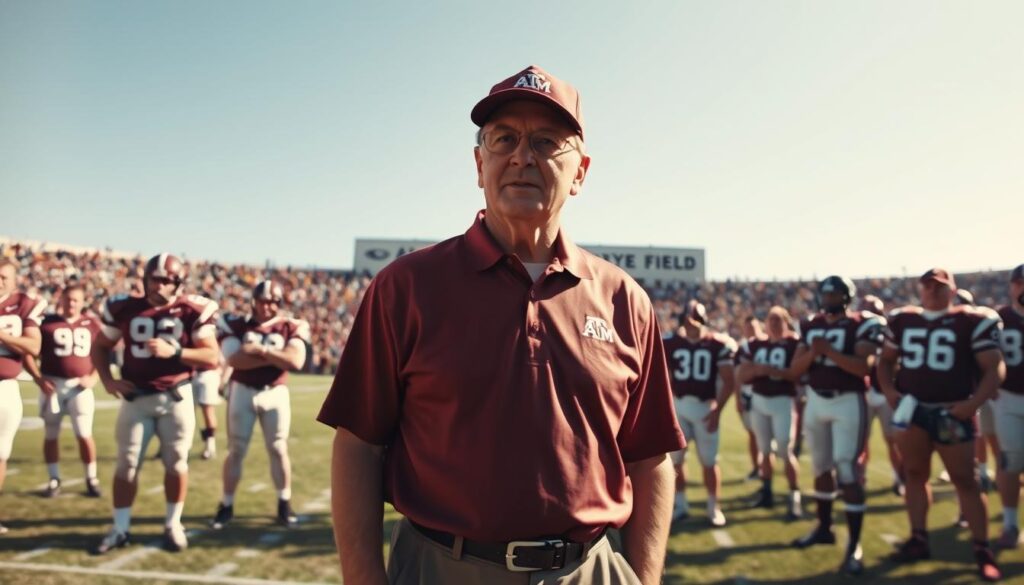
It’s like the Moneyball idea, but for toughness. While others got top talent, Stallings looked for players who overachieved. These players didn’t just play defense; they lived it.
Look for the linebackers who played with fierce control, the linemen who loved the dirty work, and the defensive backs who tackled with all their might. Their names might not be famous today, but they set the tone.
This era was about building a culture, not just winning games. A player’s value was in their leadership, discipline, and example. Their legacy is in the culture they created, not just their stats.
The Stallings coaching career at A&M was about building from the ground up. The most important players were those who focused on teaching, not just winning. They were the unsung heroes of the team.
These players were like Stallings himself, who had gone through tough times. They saw discomfort as a way to grow. This made them invaluable, even if they didn’t get much recognition.
This shows Stallings’ coaching philosophy. He valued players who fit the team, not just those who wanted to be stars. This approach built teams that were tough to beat, even if they didn’t have many stars.
The impact of these players was huge. They built a foundation of toughness that lasted long after Stallings left. The Aggies became known for their discipline and hard work.
Even though we might not remember their names, we remember the type of player they were. The hard-nosed, disciplined Aggie became the standard. They weren’t stars; they were the foundation.
Recruiting in the SWC Era
Imagine trying to sell a military academy lifestyle to 18-year-olds during the Summer of Love. That was Gene Stallings’ challenge at Texas A&M in the late 1960s. While his SWC rivals talked about campus parties, Stallings discussed morning reveille.
The odds were against him. Texas boasted Austin’s growing music scene. Arkansas was gaining national attention. A&M, on the other hand, required mandatory Corps of Cadets membership. This was more than just a disadvantage—it was a different game.
As a Bear Bryant disciple, Stallings knew discipline was key. Yet, he faced three big hurdles. First, the university had only admitted women in 1963. The social scene was just starting.
Second, the Corps requirement turned away 99% of typical recruits. Third, and most pressing, was Vietnam. The draft lottery started in 1969. Football seemed less important when your draft number was uncertain.
This was the core challenge for any Bear Bryant disciple back then. You couldn’t attract the same players as Texas. So, Stallings looked for different types of recruits. He focused on finding players who valued discipline over glamour.
His pitch was straightforward. We offer discipline. We offer toughness. We offer a chance to grow up in a chaotic world. It was a niche market, but it existed.
For a true Bear Bryant disciple, this challenge became an advantage. The players who chose A&M were already tough. They were the hidden gems who would thrive under the Junction Boys’ system.
| Recruiting Challenge | Texas A&M’s Reality | Typical SWC School | Strategic Implication |
|---|---|---|---|
| Social Environment | Recent co-ed transition (1963), limited social scene | Established social cultures, Greek life, entertainment | Target recruits valuing structure over social life |
| Military Commitment | Mandatory Corps of Cadets participation | Optional ROTC or no military requirement | Self-selection for disciplined, team-oriented players |
| Draft Anxiety | Vietnam draft lottery active, constant uncertainty | Same national context but less military culture | Emphasize structure as preparation for any future |
| Coaching Appeal | Bear Bryant disciple with Junction Boys pedigree | Various coaching backgrounds and philosophies | Sell proven system developing toughness and character |
The table shows the market Stallings had to navigate. While rivals fought for the same recruits, A&M had a unique niche. It was small, but theirs alone.
His success in recruiting was a lesson in working with what you have. When you can’t compete for glamour, change the game. Sell what others can’t: transformation through adversity.
The Vietnam era added an eerie layer to recruiting. Coaches weren’t just competing for talent. They were also competing with the draft. A recruit choosing football over war needed deep motivation.
Stallings’ approach mirrored his mentor’s. Bryant always sought players who thrived on challenges. At A&M, the challenges themselves became the unique selling point.
This philosophy attracted specific types of players. Not always the most talented, but often the most determined. In a league dominated by big names, A&M found its way through necessity.
Coaching Philosophy and Methods
Let’s get straight to it. Gene Stallings wasn’t in College Station to teach offense. His seven-year, 27–45–1 record at Texas A&M shows he wasn’t about winning games. But, his real goal was to teach a valuable lesson.
So, what was Stallings’ Doctrine? It was all about being practical and tough. He followed the Junction Boys influence, thanks to Bear Bryant’s lasting impact. Stallings aimed to make his team strong, not to change everything.
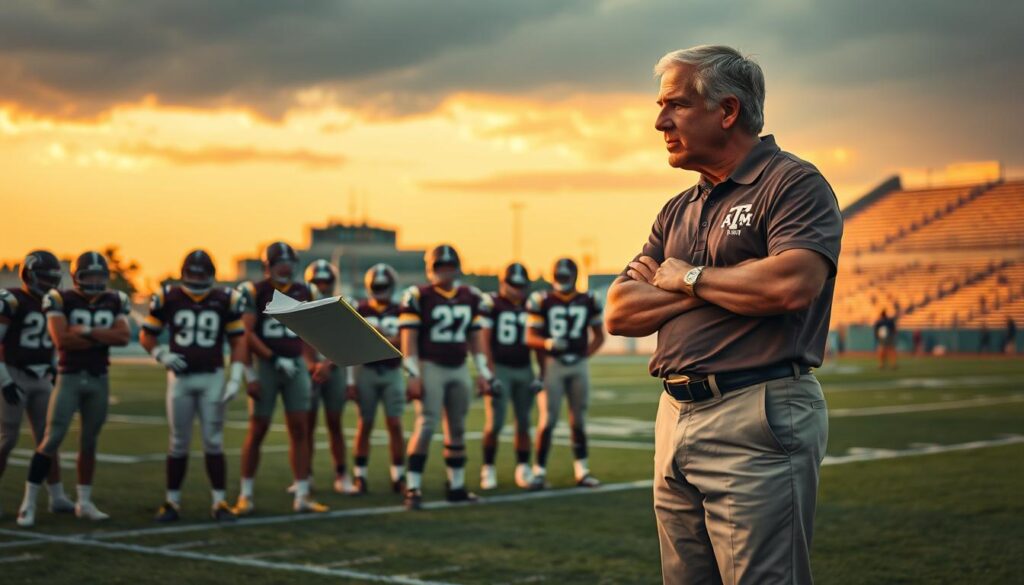
His focus was on defense, a tradition from Bryant. This was necessary because his team didn’t have top-notch offense. He believed in meticulous preparation, obsession with fundamentals, and toughness. Winning started in the film room and on the practice field, not just on game day.
The 1967 Southwest Conference championship season was his only winning year. It showed what his system could do when everything worked together. This wasn’t luck; it was the result of his hard work.
His 14-year stint with the Dallas Cowboys proved his worth. In the NFL, his defensive skills were key. His time at A&M was his lab, and with the Cowboys, he refined his ideas to win championships.
The table below shows how his Texas A&M philosophy evolved into professional success:
| Philosophical Tenet | Texas A&M Application (1965-1971) | Dallas Cowboys Refinement (1972 onward) |
|---|---|---|
| Defensive Foundation | Necessity due to roster limitations; focus on effort and toughness. | Strategic sophistication within Landry’s “Flex Defense”; reading complex offenses. |
| Teaching Method | Drilling fundamentals; building mental resilience through physical demand. | Teaching complex coverage schemes and situational football to pros. |
| Proving Ground | The 1967 SWC title proved the system could win with the right execution. | Helped multiple Super Bowl teams as a trusted assistant to a legend. |
| Legacy Output | Created a culture of discipline that lasted after he left. | Became known as one of the NFL’s top defensive minds. |
In conclusion, judging Stallings by wins and losses is unfair. The real value was in the foundation he built. College Station was just the beginning of his journey, not the end.
Memorable Games and Seasons
The story of Gene Stallings’ coaching career at Texas A&M is filled with hard work and one standout season: 1967. That year, Stallings’ discipline and tough recruiting paid off. The Aggies won the conference championship.
Winning the Southwest Conference in 1967 was a big moment for Stallings. It was his only winning season at Texas A&M. This achievement was both remarkable and isolated.
The season’s highlight was the Cotton Bowl game against Alabama and Bear Bryant. Beating Bryant was a dream come true for Stallings. When the game ended, Bryant hugged Stallings and carried him around the field.
This moment was more than just celebration. It was Bryant passing on the torch to Stallings. Bryant recognized Stallings’ hard work and beating him at his own game. This moment is the highlight of Stallings’ time at A&M.
The table below shows how special 1967 was for Stallings at A&M.
| Aspect | The 1967 Anomaly | The Overall Tenure (1965-1971) |
|---|---|---|
| Record | Winning Season (SWC Champs) | Losing Overall Record |
| Conference Finish | 1st in the SWC | Mixed, often in middle/lower half |
| Defining Moment | Cotton Bowl win over Bryant’s Alabama | The daily grind of instilling discipline |
So, what does 1967 mean in Stallings’ coaching career? It wasn’t the start of a dynasty. It was a brief moment of glory that showed his methods worked. The Cotton Bowl hug was a big endorsement of his hard work at A&M.
Developing Future Coaches
Was Gene Stallings’ time at Texas A&M a failure? It depends on how you view it. His firing after the 1971 season seemed harsh. Yet, it was a necessary step for his growth.
Every great coach needs a challenge, and College Station was Stallings’. He left with valuable lessons. Then, he joined the Dallas Cowboys in 1972.
For fourteen seasons, Stallings learned from Tom Landry. The A&M experience made him tough. The Cowboys’ system sharpened his strategic thinking. It was a chance to learn from the best.
In 1990, Stallings returned to Alabama. His 1992 team went 13–0, winning the national title. This was a triumph after years of hard work.
The College Football Hall of Fame recognized Stallings in 2011. His career shows the power of perseverance. It shows that a coach’s greatest lessons often come from challenges, not wins.