Imagine North Louisiana in 1954. A standout athlete from Springhill, John David Crow, was on the cusp of greatness. His future was as open as a Rorschach test.
Then, Paul “Bear” Bryant stepped into the picture. He wasn’t just recruiting for football. He was inviting Crow into a challenging world.
Here’s a surprising turn. Crow joined Texas A&M the same year as Bryant. But NCAA rules made him ineligible for varsity sports.
This twist of fate saved him from Bryant’s infamous Junction Boys camp. Instead, Crow focused on building a strong foundation in College Station.
He worked hard in school, earning a business degree. On the field, he waited for his chance to shine under Bryant’s guidance.
It was a perfect match: raw talent and a system that could transform it. The question was, how would he make his mark? This setup would eventually earn him a place in the Aggie Hall of Fame.
1957 Heisman campaign
The 1957 Heisman Trophy race was a battle between a defensive lineman and a versatile back. Texas A&M’s John David Crow showed what “valuable” really means. His senior year was a seven-game journey under intense pressure.
Crow played through pain. He was a true example of toughness in football. The Aggies started with eight wins, and the stakes were high.
Coach Bear Bryant made a famous statement. “If John David Crow doesn’t win the Heisman Trophy, they ought to stop giving it.” He wasn’t just praising Crow. He was saying the award’s purpose would be lost without Crow’s talent.
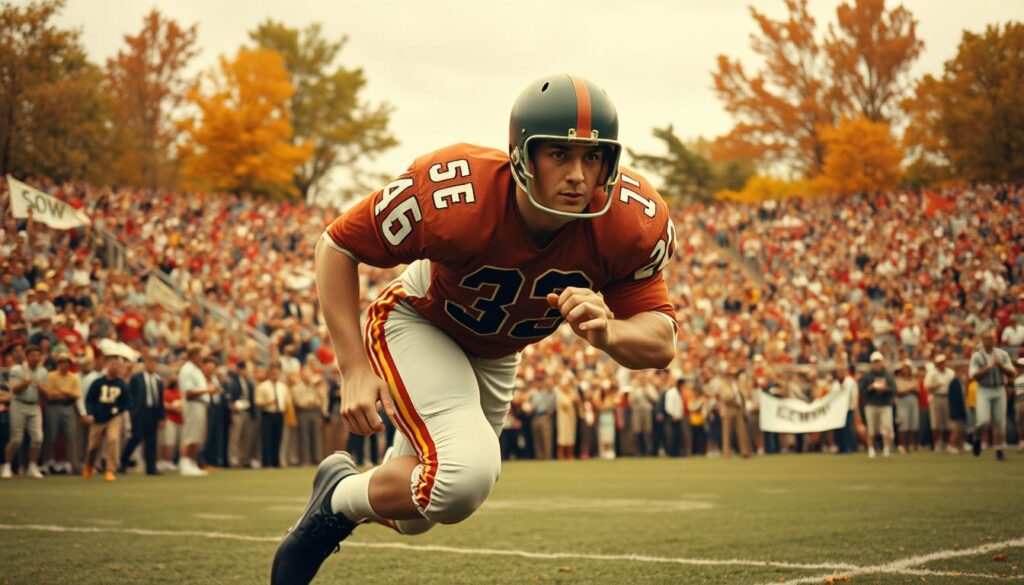
More Than Just Numbers
Crow’s stats were impressive. He was a Swiss Army knife on the field. He was key on both offense and defense.
He rushed for 562 yards and threw five touchdown passes. He also caught two passes and intercepted five balls. Crow was a nightmare for opponents.
| Category | Statistic | Impact |
|---|---|---|
| Rushing | 562 yards, 6 TDs | Primary offensive weapon for the top-ranked team. |
| Passing | 5 Touchdown Passes | Added a lethal, unpredictable dimension to the offense. |
| Receiving | 2 Receptions | Demonstrated all-around offensive skill. |
| Defense | 5 Interceptions | Game-changing plays on the other side of the ball. |
| Games Played | 7 (of 10) | Achieved all this while battling injury. |
The Ultimate Validation
On December 3, 1957, the vote confirmed Bryant’s logic. Crow won the Heisman, beating Iowa’s Alex Karras. This victory showed Crow’s value to his team.
The John David Crow awards didn’t stop with the Heisman. He was a unanimous All-American and the UPI Player of the Year. He also made the Scholastic All-America team. This was a complete sweep.
The Lasting Blueprint
Today, we admire two-way players as rare. Crow’s 1957 season is the blueprint. It showed brutal efficiency and strategic genius.
Winning the Heisman was just the start. The real story was Crow’s injured, relentless, and multifaceted domination. It’s a lasting lesson in football’s true value.
Post-college NFL stardom
If the Heisman was his thesis, John David Crow‘s NFL career was the proof of his football genius. He was picked second overall by the Chicago Cardinals in 1958. He faced the challenge of proving himself on a struggling team.
He didn’t just prove himself; he changed the game. Over eleven seasons, Crow showed how to adapt at the highest level. He played for the Cardinals and later the San Francisco 49ers.
In 1960, Crow led the NFL in yards per carry and total yards from scrimmage. He averaged 5.9 yards per carry and had 1,533 total yards. That year, he also led in fumbles, showing his flaws were also prolific.
That season, he earned NFL accolades like First-team All-Pro honors in 1959 and 1960. He was a four-time Pro Bowl selection. These awards were not just for showing up; they were for being the best.
Traded to the 49ers in 1965, Crow showed his skills as a receiver. He caught 258 passes for 3,699 yards and 35 touchdowns. His ability to run and catch made him a model for future running backs.
His career ended with a spot on the NFL’s 1960s All-Decade Team. His stats—4,963 rushing yards, 38 rushing touchdowns, and receiving numbers—show his impact. His NFL accolades prove he didn’t just succeed in the pros; he excelled.
Hall of Fame induction story
If the Heisman was the explosion, and the NFL career the shockwave, then the Hall of Fame bronze is the permanent crater. John David Crow’s 1976 induction into the College Football Hall of Fame wasn’t breaking news. It was archival. Think of it as history’s quality control department giving a final stamp of approval on a product everyone had already bought.
For the Sage archetype, this moment is delicious. The Hall isn’t a trophy case; it’s the canon. By the mid-70s, Crow’s chapter was required reading. His enshrinement was the intellectual’s seal, separating great careers from foundational ones. It validated a specific, almost extinct, brand of football: tough, smart, and two-way.
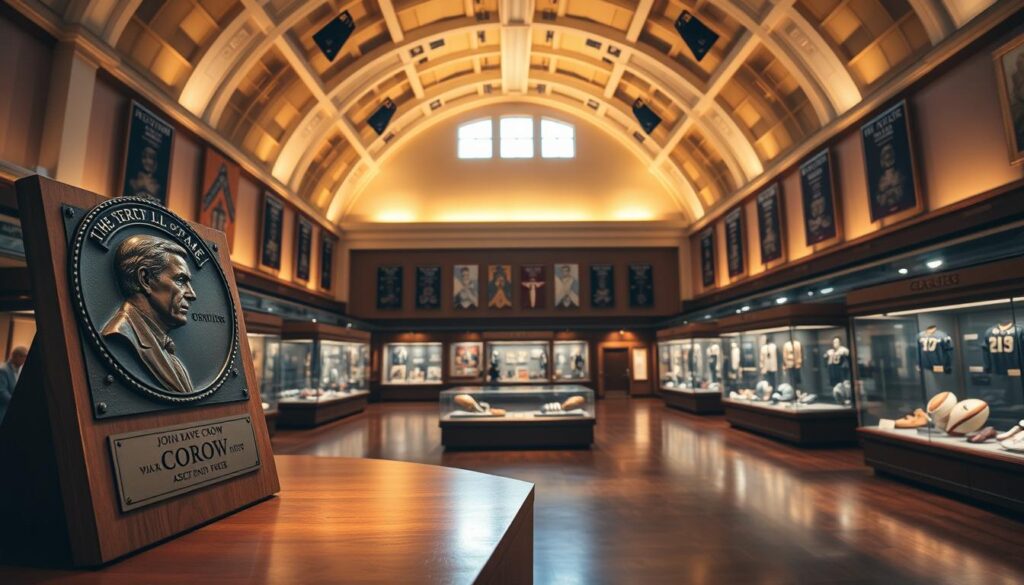
The Aggie Hall of Fame story, in its full breadth, is a lesson in layered legacy. The College Football Hall of Fame was the national coronation. Yet, his home turf had been recognizing his genius for years. The Texas A&M Hall of Fame welcomed him in 1968. That’s a telling detail. His own school didn’t wait for a national committee to confirm his worth.
1976 was a big year. He entered the Louisiana Sports Hall of Fame, too. This dual induction is a neat piece of symbolism. It captures his geographic impact, bridging Texas and Louisiana. It’s as if two states were settling their historical accounts with the same man.
The honors kept coming. The Texas Sports Hall of Fame called in 1982. Then, in 2004, he received the PricewaterhouseCoopers Doak Walker Legends Award. This award is peer-reviewed greatness. It’s voted on by past Doak Walker Award winners and the legends committee. In other words, the club itself wanted him in.
So, what’s the through-line? These aren’t random plaques. They are historical bookmarks. Each one ensures his methodology isn’t erased by modern football’s rush toward hyper-specialization. They are a distributed system of validation—local, state, national, and peer-based.
Let’s break down the official ledger. The table below isn’t just a list; it’s a timeline of a legacy being institutionalized.
| Year | Honor | Significance |
|---|---|---|
| 1968 | Texas A&M Hall of Fame | The first, and most intimate, nod from his alma mater. It set the internal benchmark. |
| 1976 | College Football Hall of Fame | The national canonization. The eternal footnote next to his career in the history books. |
| 1976 | Louisiana Sports Hall of Fame | Geographic acknowledgment, honoring his roots and impact beyond Texas borders. |
| 1982 | Texas Sports Hall of Fame | Statewide enshrinement, cementing his status as a Lone Star legend. |
| 2004 | Doak Walker Legends Award | The ultimate peer validation, awarded by fellow running back legends. |
You see the pattern? It’s a consensus built from multiple angles. The Aggie Hall of Fame journey isn’t a single event. It’s a cascade. Each induction reinforces the others, creating a lattice of legitimacy that’s hard to argue with.
In the end, the bronze bust in South Bend is just the most famous artifact. The real story is in the cumulative weight of all these honors. They collectively shout what stats alone can’t: his influence was durable, respected, and multi-dimensional. For a player defined by doing everything on the field, it’s fitting that his recognition came from everywhere off it.
Enduring Aggie influence
Legacy isn’t just about winning trophies. For John David Crow, it was about coming home. He came back to Texas A&M in 1983 as Assistant Athletic Director. He became the Athletic Director in 1988.
His time as Athletic Director was filled with challenges. But Crow made tough decisions to keep the program strong.
A street and a bronze statue now honor him. The street is near Kyle Field, and the statue was donated in 2009. He was also named Distinguished Alumnus in 2004 and SEC Legend in 2012.
“I tell everybody that A&M is my true love,” Crow said. He lived his words. The Heisman winner became an administrator, making big decisions for the university.
John David Crow didn’t just enter the Aggie Hall of Fame. He helped shape the university. His journey from player to leader is detailed in this look at his career. He became a part of the university’s history, a lasting landmark.