I keep returning to one thought about Von Miller’s career: some players don’t just arrive, they change the whole game. Before the Denver Broncos and Super Bowl MVP confetti, he was a Texas kid with a quick first step. Quarterbacks didn’t know him yet, but soon their sleep schedules would change.
At Texas A&M, Miller’s story was more than talent; it was about adapting. He wasn’t stuck in one position because his top skill was turning space into pressure. This switch sharpened his timing and angles, like letting a chess player sprint on the board.
Is it any surprise his pass rush became a solved puzzle?
When Denver picked him second overall on April 28, 2011, the choice seemed simple. Coach John Fox said the decision was unanimous and praised Miller’s ability to play all four downs with rare energy. He compared Von to Julius Peppers, saying Von was even more explosive.
That might sound boring, unless you are the offensive coordinator holding the stressful play sheet. Then it means everything.
Thesis: the evolution of an elite edge
A Von Miller career retrospective works best if you treat it like a three-act film, minus the cheesy montage.
Act one is the clean, high-conviction pick: Denver at No. 2 overall, when John Fox called the choice “unanimous.”
The subtext was louder than the quote. They wanted a defender who could play on “all four downs,” not a part-time blur with fresh legs.
Act two is where the pass rush turns from skill into leverage.
Fox floated the Julius Peppers comparison, then topped it with “even more explosive,” which sounds like draft-room caffeine talking.
Then Miller proved it: double-digit sacks seven times, 18.5 in 2012, and weekly pressure that bends protections and wrecks play clocks.
That arc hits a very public peak when the Super Bowl MVP label stops being a prediction and becomes a line on the résumé.
Act three is the part nobody wants on the poster.
Buffalo’s 2022 bet gets mocked in a re-grade culture that treats context like an optional app update.
Brandon Beane was chasing a closer after the Chiefs game that ended with 13 seconds left. He paid for the NFL’s active all-time sack leader and hoped the pass rush would finish what the offense started.
The early return looked logical: eight sacks in 11 games, pressure rates trending the right way, and protection schemes sliding like they knew the answer.
Then Thanksgiving detonated the plan with an ACL injury, and the story shifted to rehab timelines, workload management, and a reworked deal.
In a Von Miller career retrospective, that’s the pivot point where greatness becomes a math problem.
| Act | Identity on Sundays | Signature proof points | How offenses reacted | What changed next |
|---|---|---|---|---|
| Prospect-to-certainty (Denver No. 2) | Every-down edge with range | John Fox called the pick “unanimous”; valued “all four downs” | Early chips and tight end help to slow the first step | Role expands from rusher to complete defender |
| Peak weaponization | Closer who dictates protections | Double-digit sacks seven times; 18.5 in 2012; Super Bowl MVP | Slide protections, quick game, and heavier play-action to hide the dropback | Offense and coordinators build weekly plans around surviving him |
| Aging, injuries, recalibration (Buffalo) | High-impact specialist with managed volume | Signed after the “13 seconds” loss; eight sacks in 11 games before ACL; reworked deal | Fewer deep drops when he’s on the field; more quick throws to the hot side | Availability and snap economics become part of the evaluation |
High school to Aggieland: recruiting and position switch
The funny thing about origin stories is how little they feel like destiny while you’re living them.
In any Von Miller career retrospective, the jump from high school buzz to college reality looks clean on paper.
In real time, it’s more like trying to build a jet engine during turbulence.
What made Von Miller Texas A&M compelling wasn’t a glossy “can’t-miss” label.
It was the bet that his athletic range could survive a bigger stage, faster linemen, and a playbook that doesn’t care about your mixtape.
Mike Sherman has talked about that early push-and-pull: the talent was obvious, but the path needed shaping.
Then came the position switch, which sounds like trivia until you watch what it unlocked.
Becoming an Aggies linebacker meant learning to play in space, set an edge, and still threaten the quarterback like a heat-seeking rumor.
That blend—coverage ability with pass-rush violence—foreshadowed the four-down utility that pro coaches later treated like found money.
The early college phase also has that quiet adversity that every honest Von Miller career retrospective must include.
The learning curve was steep, the expectations loud, and the weekly assignments unforgiving.
The point wasn’t to turn him into a “specialist.” It was to widen the tool belt until the offense had to account for him on every snap.
| Shift | What changed on the field | Why it mattered later |
|---|---|---|
| High school star to SEC-level speed | Less free space, quicker reads, tighter angles to the ball | Forced processing speed that travels from Saturdays to Sundays |
| Position switch into an Aggies linebacker role | More reps in coverage, more edge setting, more disguise work | Built the “not just a rusher” profile that fits every down |
| From flashes to weekly disruption | Turned burst into plan: counters, leverage, and timing | Set the foundation for being drafted as a franchise-shifting defender |
So when people shorthand Von Miller Texas A&M as a straight line to stardom, I have to laugh.
The more accurate version is messier—and better.
You can see the identity forming: not a niche pass rusher, but a defender built to stress a game plan until it cracks.
A&M years: breakout games, Wrecking Crew ethos, advanced stats
When Von Miller Texas A&M started in 2007, the “Wrecking Crew” label wasn’t just a throwback. It was a job description: play fast, play loud, and make quarterbacks feel like they forgot their lines on live TV.
The coaching pitch was simple and a little ruthless. Build an Aggies linebacker who could bully tackles, embarrass tight ends, and still have the gas to run the next snap.
That promise mattered because it framed his growth as craft, not luck.
The ethos was speed and chaos, the kind that forces protection calls to get messy. A&M had already sent waves of defenders to the league.
The message was basically, “You’re next—prove it.” Under Mike Sherman, the pressure wasn’t hidden; it was baked in.
That adversity note shows up in the way his game sharpened. The pass rush stopped being a single move and became a plan: threaten the edge, bend late, counter inside, then chase like the play is personal.
Fox later called it “all four downs,” which means no sub package can contain him.
The team results caught up with the violence. You can see the defense climb in a straight line, like a stock chart before the memes ruin it.
| Season | National defensive rank | Opponent points per game | What it suggested on film |
|---|---|---|---|
| 2008 | 32nd | 24.1 | Flashes of disruption, but too many clean pockets |
| 2009 | 12th | 18.4 | Pressure arriving earlier; protections sliding his direction |
| 2010 | 5th | 16.3 | Quarterbacks speeding up; routes breaking down under heat |
Individually, the résumé reads like a scouting department’s love letter. As an Aggies linebacker, he stacked 27.5 career sacks—second in school history.
He detonated in 2009 with 17 sacks and Big 12 Defensive Player of the Year honors.
By 2010, the labels changed from “dangerous” to “decorated,” with First-team All-American honors.
If you want the quick snapshot, his Texas A&M dominance wasn’t built on one hot month; it was a repeatable weekly problem.
The advanced-stats lens just gives numbers to an old truth: quarterbacks hate pressure more than they love completions.
When the pass rush makes a passer reset his feet, the playbook shrinks, the checkdowns pile up, and the offense starts calling “safe” plays that don’t scare anyone.
And that’s why Von Miller Texas A&M felt like a system-breaker, not a system-product. Offenses didn’t just lose yards; they lost options.
That’s the quiet part that scouts obsess over—can this defender stay on the field, dictate protections, and make the other team change its plan?
Draft process and early NFL impact
April 28, 2011, marks a key moment in Von Miller’s career. That night, the Denver Broncos picked him No. 2 overall. They dared the league to keep up with their choice.
The team’s logic was simple but bold: if you can’t fix everything at once, wreck the pocket first. Quarterback debates can drag on, but a strong pass rush pays off right away.
The Denver Broncos weren’t taking a guess. John Fox said they were “unanimous the last two weeks.” That shows their decision was based on solid facts, not chance.
They studied film, workouts, and interviews. The team reached a group agreement after much debate. Everyone was ready to move on and support the pick.
“Play all four downs.” This phrase stands out because it mixes scouting insight with practical planning. Fox called Miller “dynamic” and said, “we liked him as a young man.”
This shows the evaluation went beyond stats. It included Miller’s character and locker-room fit, which often makes the biggest difference.
“More explosive.” Fox compared Miller to Julius Peppers, a Hall of Famer. It was a bold but fitting comparison based on Miller’s early tape.
Miller’s quick first step, bend, and pressure changed plays fast. His pass rush made clean plays turn into panic within seconds.
Then came the 2011 lockout. The NFL put rookies in a tough spot. They faced fewer practice reps and shorter learning time.
Veteran linemen knew the game well. Rookies had to learn fast and keep up with the speed. The Denver Broncos faced a rough start, not a smooth flight.
Still, Miller’s impact came quickly. Disruption brought clarity to offenses. Defenders forced offenses to adjust protections and slide help often.
In this Von Miller career retrospective, pressure was more than force; it was a constant challenge offenses had to plan for weekly.
| Draft-room focus | What the Denver Broncos were buying | Early NFL effect on pass rush |
|---|---|---|
| “Unanimous the last two weeks” | Clear internal conviction, less second-guessing on draft night | Faster role clarity, fewer snaps wasted on tryouts |
| “Play all four downs” | Every-down defender, not a specialty piece | More predictable pressure packages, fewer substitution tells |
| “Dynamic” athletic profile | Burst, bend, and range that stress protections | Forces chips and slides that open lanes for others |
| “We liked him as a young man” | Trust in preparation, coachability, and locker-room fit | Quicker adjustment when the playbook speeds up on Sundays |
| Peppers comparison, “more explosive” | Bet on rare traits translating at pro speed | Edge wins that turn timing routes into throwaways |
| 2011 lockout backdrop | Less teaching time, more self-driven learning | Technique had to travel fast from meeting room to game day |
The draft was not just hype; it was a clear plan. The Denver Broncos did not promise perfection. They aimed to gain an advantage.
In this Von Miller career retrospective, that first rush wave shows when the franchise stopped waiting and started shaping its future.
Peak years and Super Bowl run: signature moves and film notes
Some stars get hype because we like a good story. Von Miller got hype because tackles couldn’t breathe around him.
In his peak with the Denver Broncos, the numbers felt like a cheat code. He had 106 career sacks in franchise colors. He achieved seven double-digit seasons over nine years.
His 18.5-sack season in 2012 was especially impressive.
But the tape tells the true story. Miller’s pass rush shows up on first down, not just obvious moments. That’s when offenses change plays nervously, like avoiding spilled coffee.
Miller’s signature move is the bend-and-burst rhythm. He threatens the edge, dips his shoulder, then flattens toward the quarterback like a shortcut home.
His hands are fast, but his feet are the real trick. They win space early and steal the angle late.
This is why protections shift. Slide calls aim at him, tight ends chip, and backs step up like reluctant volunteers. Even when he doesn’t sack, his rush changes the quarterback’s setup and timing.
Super Bowl 50 showed this best. Miller didn’t just pressure Cam Newton; he changed the timing of the whole Carolina offense. He left as Super Bowl MVP.
And the team around him mattered too. DeMarcus Ware’s late Broncos run aged like a fine plot twist. In 2015 playoffs, Ware had 3.5 sacks over three games, forcing offenses to guess which threat to double.
| What shows up on film | Why it matters | How offenses try to answer |
|---|---|---|
| Wide-9 alignment and a fast first step | Forces tackles to open early and give up the corner | Quicker sets, extra depth in the pocket, early throws |
| Speed-to-power conversion | Turns “safe” kick slides into a collapsing edge | Guard help, tighter splits, half-slide protection |
| Inside counter off the same get-off | Punishes oversets and creates direct paths to the QB | Chips, firm inside hands, backs scanning inside-out |
| Pairing with DeMarcus Ware on the opposite side | Prevents offenses from living in one protection plan | More max protect, fewer deep routes, simplified reads |
When coaches say he’s a “four downs” problem, this is why. The Broncos didn’t need him for third-and-long heroics. They wanted him to make every series feel shorter.
The sneaky part: pass rush is not just sacks. It makes quarterbacks speed up their thinking. Play-callers shrink their options before the huddle breaks.
Leadership, community work, and brand
In any Von Miller career retrospective, leadership is where the legend meets the receipts. Guys can talk “alpha” all day, but the locker room keeps score.
The Denver Broncos didn’t just bet on talent; they invested in structure, standards, and the unglamorous work of growing up.
That’s where DeMarcus Ware shows up like a veteran professor who doesn’t need to raise his voice.
Ware said his leadership “made the biggest impact.” He set an example for a “young, talented pass rusher named Von Miller.”
Ware helped him “get his life and career back on track.” Not a slogan. Not a commercial. A real person changing the trajectory.

Once you’ve got that kind of mentorship, the brand stops being a costume.
It becomes an extension of the tape. A Super Bowl MVP label only sticks when teammates trust the day-to-day habits behind it—film study, practice tempo, and how you handle Monday after a loss.
Community work fits into the same category: visible, sure, but also measurable.
When a star shows up consistently, people notice the pattern, not the photo op.
The Denver Broncos market is sharp that way; fans can spot “PR-only” from a mile away, usually before halftime.
| Leadership lever | What it looks like up close | Why teammates buy in | How the brand becomes believable |
|---|---|---|---|
| Mentorship (DeMarcus Ware) | Modeling routine, correcting details, setting tone in meetings | It’s behavior, not hype; the standard is clear | Reputation shifts from headline-driven to habit-driven |
| Performance credibility | Pro Bowls, first-team All-NFL caliber stretches, pressure that changes protection plans | Production forces respect, even from skeptics | Super Bowl MVP status reads like validation, not marketing |
| Community consistency | Recurring appearances, youth-focused work, showing up outside the spotlight | Players recognize authenticity when it costs time | The public image matches the private effort |
| Accountability in the building | Owning mistakes, resetting weekly goals, setting effort baselines | Trust rises because excuses drop | Fans and sponsors see stability, not a mood swing |
The funny thing about “personal brand” in the NFL is you can’t outsource authenticity.
You either have the tape, or you have a marketing team yelling into the void.
In a Von Miller career retrospective, the cleanest through-line is how credibility—built with the Denver Broncos and capped by a Super Bowl MVP moment—turns leadership from myth into mechanics.
Injuries, comebacks, and late-career chapters
In any Von Miller career retrospective, this is where the hype turns into heartbeat. One moment you’re analyzing edge angles and get-off times. The next, you face a medical report like an unexpected plot twist.
After years of seeing him break tackles for the Denver Broncos, I understood why teams kept paying for that pressure. A great pass rush isn’t just about stats—it shifts the mood late in the game.
Buffalo’s bet looked clean: in 2022, the Bills signed Miller for six years and $120 million. The deal included $45 million guaranteed. Some called it “head-scratching,” which means ignoring the context on purpose.
The context: Buffalo had just lost an AFC Divisional Round to the Chiefs, despite leading with 13 seconds left. Brandon Beane searched for the missing piece: a closer. An elite pass rush who could end drives before time ran out.
At first, it seemed smart. Miller started hot with eight sacks in 11 games. He brought the chaos that once fueled Denver’s defense. Then Thanksgiving came, along with a torn ACL that ended his season and playoff chance.
2023 was a tough year. He missed the season start, played 12 games without starts, and had only three tackles. Miller recorded no sacks—the first zero-sack year of his career. Recovery rarely follows a neat narrative.
Money complicated the story, as it often does. Many saw the deal as closer to a three-year commitment. Miller reworked it in 2024, making it incentive-laden, with a $1.5 million base salary and a possible exit after 2024.
| Chapter | What the team needed | What happened on the field | What it said about pass rush economics |
|---|---|---|---|
| Bills signing (2022) | A late-game closer after the Chiefs loss and the 13-second collapse | Hot start: 8 sacks in 11 games before the injury | Teams pay a premium for disruption, not just snap counts |
| ACL setback (Thanksgiving 2022) | Keep the defense’s top pressure threat available for January | Torn ACL ended his season and removed him from the playoff push | One ligament can flip “bold move” into “bad contract” overnight |
| Return year (2023) | Get functional production while he rebuilt strength and timing | 12 games, 0 starts, 3 tackles, 0 sacks | Decline and injury look identical until explosiveness comes back |
| Reworked deal (2024 offseason) | Align cap reality with a prove-it runway | $1.5M base salary with incentives; potential out after 2024 | Risk shifts from team to player when availability becomes the question |
Here’s an uncomfortable truth from this Von Miller career retrospective: the line between “decline” and “injury” is often one ligament. The Denver Broncos years showed us his peak. The late-career chapters test if his pass rush can still change games when the body struggles.
Behind-the-scenes stories from A&M and NFL
Behind the curtain is where the good stuff lives, so I lean on the quotes that don’t sound like marketing copy.
In my Von Miller career retrospective, the Denver Broncos draft-room chatter is the tell: John Fox calling it “unanimous” late in the process.
He described a player who stays on the field for all four downs. That’s not poetry. That’s personnel people admitting they saw a problem defenses couldn’t solve.
Fox’s Julius Peppers comparison lands because it’s both flattering and clinical. “Dynamic.” “By himself.” And the kicker: “even more explosive.”
It’s the NFL version of a lab report—traits, translation, projection. The Denver Broncos didn’t draft a stat line; they drafted a set of levers that would change game plans.
Back in College Station, Von Miller Texas A&M wasn’t a straight climb; it was more like a stock chart during an election year.
The Mike Sherman era tried to make Saturdays look like Sundays, with a pro-style mindset and a sharper edge in practice.
If you want the texture behind that approach, the Mike Sherman NFL-style blueprint helps explain why “potential” was treated like a job requirement, not a compliment.
That’s where the adversity thread matters, the one tied to coaches like Sherman and assistants like Tim DeRuyter.
The message wasn’t subtle: prove it, then prove it again when the plan breaks.
In a Von Miller career retrospective, that context makes the origin story feel less like destiny and more like daily work—film study, leverage, hand usage, repeat.
Then the league tossed in the 2011 lockout, because of course it did.
Rookies had to build pro habits in a disrupted offseason, with fewer reps and less time to breathe.
For the Denver Broncos, early impact under those conditions said something extra: mental processing, routine, and how fast a player can turn coaching into muscle memory.
| Behind-the-scenes angle | What was really being evaluated | Why it mattered later |
|---|---|---|
| Draft-room “unanimous” talk in Denver | Consensus on traits, role fit, and snap-to-snap reliability | Turned hype into clarity: a defender planned for every situation |
| “All four downs” framing | Special teams value plus third-down pass-rush utility | Created lineup flexibility and disguised pressure looks |
| Peppers comp with “more explosive” add-on | First-step burst, bend, and closing speed in space | Forced offenses to account for one player like a system |
| Von Miller Texas A&M pro-style development | Terminology, film discipline, and technique under structured teaching | Made the transition to NFL rules and detail work less jarring |
| 2011 lockout adjustment | Self-driven preparation and learning speed without normal onboarding | Separated routine builders from talent-only bets |
The funny part is how the NFL pretends greatness is linear, like a neat résumé bullet list.
It isn’t. This Von Miller career retrospective works better when you treat those quotes and context as the real timeline—how evaluators talked, how coaches taught, and how the Denver Broncos measured readiness when the calendar refused to cooperate.
Miller’s place among all-time Aggies and NFL peers
Ranking debates often mix logic with feelings. But talking about an Aggies linebacker alongside NFL royalty needs proof.
Von Miller provides plenty of evidence to back his place among the best.
Start with the Denver Broncos résumé. He holds the franchise record with 106 sacks and had seven seasons with double-digit sacks over nine years.
His best year was 2012 with 18.5 sacks. Add eight Pro Bowls and three first-team All-NFL honors, and his case grows stronger.
Many remember the Super Bowl MVP award. But the game film shows why he earned it. In Super Bowl 50, Miller pressured Cam Newton from start to finish, disrupting the opponent’s plan.
| Measuring Stick | Von Miller | What it signals in the Denver tier |
|---|---|---|
| Franchise sacks | 106 (Denver Broncos record) | Longevity plus prime dominance, not a one-season spike |
| Peak sack season | 18.5 (2012) | Top-of-market pass-rush production in a pass-happy era |
| Double-digit sack seasons | 7 in 9 years | Consistency that forces weekly protection rules |
| Accolades | 8 Pro Bowls, 3 first-team All-NFL | League-wide validation across multiple seasons |
| Signature playoff stamp | Super Bowl MVP (Super Bowl 50) | Peak performance when the entire sport is watching |
I place Miller among the Broncos’ greats like Peyton Manning and Champ Bailey. They didn’t play the same position, but all owned their era.
Opponents had to plan specifically for them. That kind of impact defines true greatness.
Miller was never alone. DeMarcus Ware added veteran calm, and the No Fly Zone—Aqib Talib and Chris Harris Jr.—forced quarterbacks into mistakes.
Miller created front-end chaos that turned coverage challenges into near certainties.
Across the league, Buffalo proved his value by trading for him. At the time, Miller was the NFL’s active all-time sack leader.
This status is rare and highly valuable in the pass-rush market. The scarcity of his skill set raises his worth.
When critics say “system” or “stacked rosters,” I see it as praise disguised. Denver’s system worked because Miller made tough plays look routine.
Best games to rewatch and film-room pointers
If you’re doing a Von Miller career retrospective, skip the hype reels and grab a notepad. The best tape shows why the offense starts flinching. Pass rush is “violence,” but it’s also leverage, tempo, and making a quarterback play like the pocket is shrinking fast.
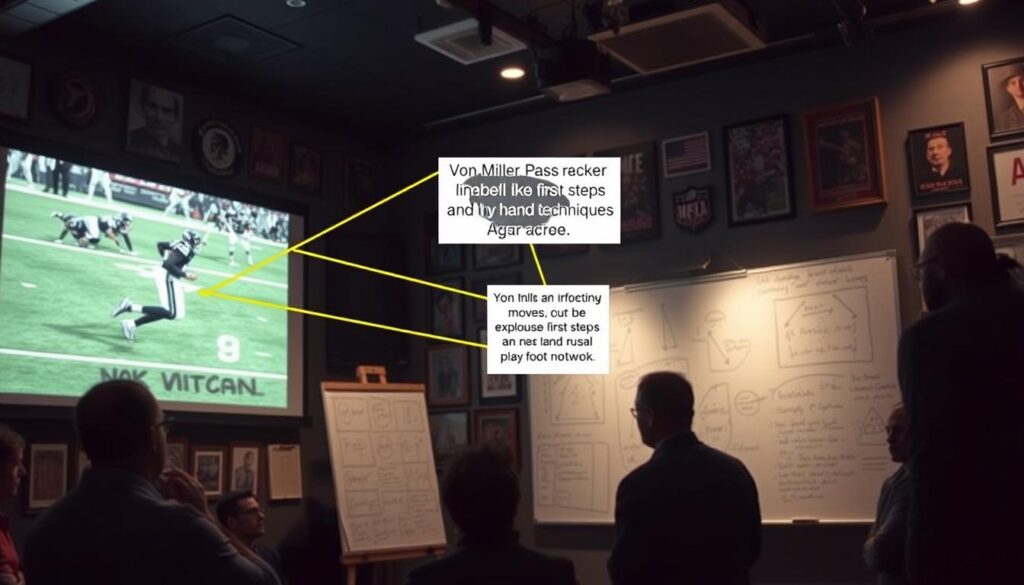
The non-negotiable rewatch is Super Bowl 50. Miller didn’t just have a big night—he played like a problem the Panthers couldn’t solve. The Super Bowl MVP label is basically the receipt. Watch how pressure affects Cam Newton’s footwork and eye drops. Ball security starts looking like an optional feature.
Then jump to 2012, Miller’s peak season with 18.5 sacks and very little “he got lucky” energy. Fox’s trick was to evaluate all downs, not just third-and-long plays. The real lesson is snap-to-snap consistency: get-off, hand usage, and how often the tackle loses leverage even when the play ends.
For late-career study, look at early Buffalo in 2022: eight sacks in 11 games. This shows veteran pass rush—less pure speed, more timing and counters like a chess player. Then contrast it with the post-ACL injury reality after Thanksgiving and the 2023 line: 12 games, zero starts, three tackles, zero sacks. This shows what changes when explosion and trust aren’t guaranteed.
| Rewatch window | What to track on film | Why it matters |
|---|---|---|
| Super Bowl 50 (Broncos vs. Panthers) | Alignment tells, get-off timing, strip attempts, QB mechanics under heat | Shows how a Super Bowl MVP game is built on repeatable pressure, not one miracle snap |
| 2012 season peak (18.5 sacks) | First-step consistency, edge leverage, counters after contact, effort on “dead” downs | Turns a Von Miller career retrospective into a study of down-to-down dominance |
| Early 2022 with Buffalo (8 sacks in 11 games) | Rush plan sequencing, inside-out counters, pacing to set up the tackle | Explains how pass rush can age gracefully when speed isn’t the only pitch |
| Post-ACL 2023 stretch | Change in bend, hesitation at the top, fewer power conversions, tighter angles | Helps you see what disappears first when the body won’t cash the old checks |
Film-room pointer I keep coming back to: look for the “tell” before the win. Is he widening the tackle, threatening inside, or forcing oversets? These make the offense admit it’s scared. The best reps aren’t always sacks—they’re the snaps where protection moves early and the play gets conservative.
What’s next and lasting legacy
In any Von Miller career retrospective, the legacy math is almost rude in how clean it looks. The Denver Broncos made him the No. 2 overall pick in 2011. He played like the kind of “can’t-miss” projection that never stays theoretical.
He piled up 106 sacks in franchise colors and lived in double digits more than once. He stacked Pro Bowls and first-team All-NFL like they were punch cards.
Then there’s the stamp that never fades: Super Bowl 50 MVP. That night didn’t just win a ring for the Denver Broncos. It wrote his name into the league’s permanent memory.
Watch the burst, the bend, the timing—Miller didn’t chase quarterbacks so much as he edited their game plans in real time.
But the present tense is less polite. The Buffalo deal became a live case study: hot start in 2022, an ACL tear on Thanksgiving. Then no sacks in 2023.
By 2024, the contract shifted to incentives, with a $1.5 million base and a possible out after the season. This shows NFL certainty lasts about as long as a trending topic.
From Von Miller Texas A&M disruptor to Denver Broncos folklore to a veteran still hunting one more January run, the arc refuses a tidy ending.
Careers aren’t only defined by how they end. They’re tested there. In this Von Miller career retrospective, that’s the least fashionable truth and maybe the most American one.